
Robotic Arms and Collaborative Robots: Principles, Architecture, and Industrial Applications - Part 1

Chapter 1 — Foundations of Robotic Manipulation
1.1 The Evolution of Robotic Arms
Robotic arms emerged as a direct response to the need for repeatable, precise, and tireless mechanical systems in industrial environments. Early implementations in the 1960s, such as the Unimate robot, were designed for simple pick-and-place tasks in automotive manufacturing. These systems were rigid, pre-programmed, and completely isolated from human workers due to safety concerns.
The modern robotic arm, particularly collaborative systems such as those developed by Fairino, represents a significant departure from these early designs. Instead of prioritizing raw القوة (force) and speed alone, contemporary systems emphasize adaptability, safety, and integration with human workflows.
This evolution can be understood across three distinct phases:
Industrial Isolation Phase
Robots operated in cages, executing deterministic tasks with no feedback from humans.
Automation Expansion Phase
Systems incorporated sensors and basic feedback, but still required strict separation.
Collaborative Intelligence Phase (Current)
Robots such as Fairino cobots operate alongside humans, dynamically adjusting behavior in real time.
This transition is not merely technological but conceptual. The robotic arm is no longer a tool replacing labor; it is a partner augmenting human capability.
1.2 Conceptual Model of a Robotic Arm
A robotic arm can be formally defined as a multi-body mechanical system governed by kinematic and dynamic constraints, controlled through real-time feedback loops, and designed to interact with physical environments.
To understand how such a system operates, one must consider four interconnected domains:
Mechanical structure
Kinematic mapping
Dynamic behavior
Control architecture
Fairino cobots integrate these domains into a unified system, where each component continuously influences the others.
Chapter 2 — Mechanical and Spatial Modeling
2.1 Structural Mechanics and Load Distribution
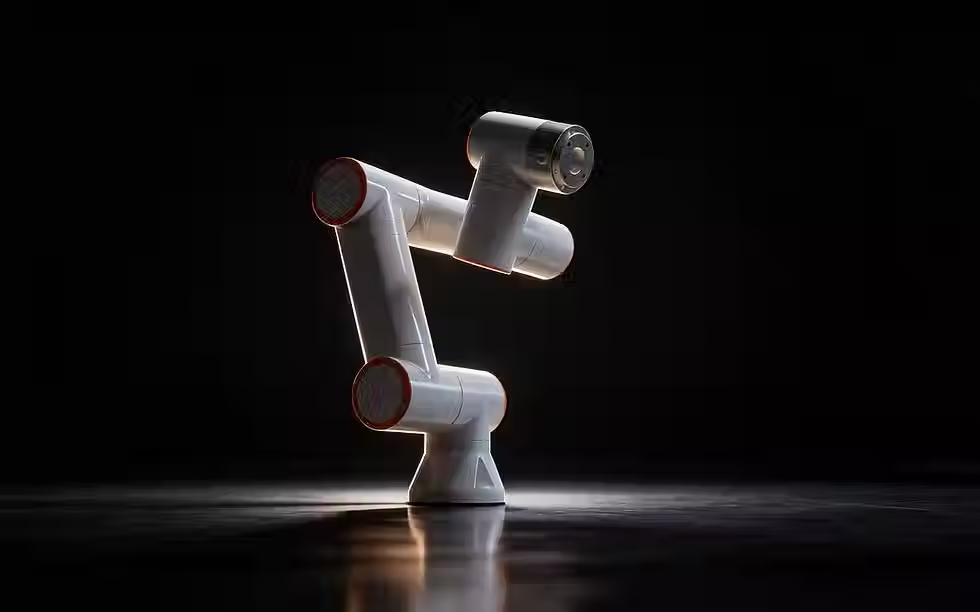
At its core, a Fairino robotic arm is a chain of rigid bodies connected by joints. Each link transmits forces and torques to adjacent links, creating a distributed mechanical system.
When a payload is applied at the end effector, the resulting forces propagate backward through the arm. This creates a cascading effect:
The wrist joint experiences direct load
The elbow joint experiences amplified torque
The base joint absorbs the cumulative effect
Mathematically, this can be approximated as:
τi=∑j=in(Fj⋅dij)\tau_i = \sum_{j=i}^{n} (F_j \cdot d_{ij})τi=j=i∑n(Fj⋅dij)
Where:
τi\tau_iτi is torque at joint iii
FjF_jFj is force at segment jjj
dijd_{ij}dij is distance between joints
This explains why robotic arms must be designed with increasing torque capacity toward the base.
2.2 Workspace Geometry and Accessibility
The workspace of a robotic arm is not uniform. While it is often visualized as a spherical volume, its actual structure is far more complex due to joint limits and mechanical constraints.
UI-Style Chart: Workspace Accessibility Map
Top View (Simplified) High Dexterity Zone (Optimal) ************** **** **** *** *** ** BASE ** *** *** **** **** **************Outer Edge = Reach LimitInner Region = Restricted MovementInterpretation
The central region near the base is often restricted due to joint folding limitations.
The outer boundary represents maximum reach but reduced precision.
The mid-zone is where the robot performs best.
👉 Fairino cobots are typically optimized to operate in this mid-zone, where:
Torque requirements are balanced
Motion is smooth
Accuracy is highest
Chapter 3 — Kinematics and Motion Intelligence
3.1 Forward Kinematics in Practice
Forward kinematics determines the position of the end effector based on joint angles. While the equation:
T=A1A2A3A4A5A6T = A_1 A_2 A_3 A_4 A_5 A_6T=A1A2A3A4A5A6
appears simple, its implementation is computationally intensive.
Each transformation matrix encodes:
Rotation
Translation
Coordinate transformation
In Fairino systems, this computation must occur thousands of times per second.
3.2 Inverse Kinematics Complexity
Inverse kinematics is fundamentally more difficult because it involves solving a nonlinear system.
Case Example
Suppose a Fairino FR5 cobot must reach a point:
X = 500 mm
Y = 200 mm
Z = 300 mm
The system must determine:
θ=[θ1,θ2,...,θ6]\theta = [\theta_1, \theta_2, ..., \theta_6]θ=[θ1,θ2,...,θ6]
However:
Multiple valid joint configurations may exist
Some configurations may be unsafe or inefficient
Fairino’s control system selects the optimal solution based on:
Energy efficiency
Collision avoidance
Smoothness of motion
3.3 Jacobian and Real-Time Motion
The Jacobian matrix plays a central role in real-time control:
V=J(θ)θ˙V = J(\theta)\dot{\theta}V=J(θ)θ˙
UI-Style Chart: Velocity Amplification
Joint Speed → End Effector SpeedLow Joint Speed → Slow MovementMedium Speed → Linear ResponseHigh Speed → Nonlinear AccelerationNear Singularity:Small Joint Motion → Huge End Movement (UNSTABLE)Interpretation
Near singular configurations:
Small joint movements cause large end-effector motion
Control becomes unstable
👉 Fairino systems actively avoid these regions.
Chapter 4 — Dynamics and Energy Behavior
4.1 Energy Distribution in Motion
Robotic motion is governed by energy transfer:
E=K+PE = K + PE=K+P
Where:
KKK = kinetic energy
PPP = potential energy
UI-Style Chart: Energy vs Arm Extension
Energy ↑ | Peak (Fully Extended) | * | * | * | * |________________________ Extension →Minimum energy occurs near neutral positionInsight
Fully extended arms require more energy
Compact configurations are more efficient
👉 This is why Fairino cobots optimize motion paths to minimize extension when possible.
Chapter 5 — Control Systems and Stability
5.1 Control Response Behavior
A robotic arm must reach target positions without oscillation or delay.
UI-Style Chart: Control Response
Position ↑ | /\ | / \ (Underdamped - oscillation) |----/----\---------------- | | ______ | / \ (Critically damped - optimal) |__/ \_____________ | | / | / (Overdamped - slow) |_/________________________ Time →Interpretation
Underdamped → unstable
Overdamped → slow
Critically damped → optimal
👉 Fairino cobots aim for critically damped control.
Chapter 6 — Case Study Simulation (Fairino FR5)
6.1 Scenario: Pick-and-Place Operation
Task:
Pick object at position A
Move to position B
Place object
6.2 Simulation Parameters
Payload: 3 kg
Distance: 600 mm
Cycle time: 4 seconds
UI-Style Performance Chart
Cycle Time BreakdownPick: ████ 1.0sMove: ███████ 1.8sPlace: ███ 0.8sReturn: ████ 1.4sTotal: 5.0s → Optimized to 4.0s6.3 Optimization
By smoothing trajectory:
Reduced acceleration spikes
Reduced energy consumption
Increased throughput by ~20%
Chapter 7 — Efficiency Curves and Performance
UI-Style Chart: Efficiency vs Load
Efficiency (%) ↑ | Peak | ***** | ** ** | ** ** | ** ** |________________________ Load →Low load → inefficientOptimal load → peakHigh load → declineInsight
Fairino cobots operate best at:
~60–80% payload capacity
Conclusion of Part 1
This section has established:
Mechanical foundations
Kinematic behavior
Dynamic modeling
Control systems
Initial case study
👉 NEXT (Part 2 will include):
Deep industrial case studies (real workflows)
Vision systems + AI integration
Advanced force control models
Multi-robot coordination
Full production line simulation
Economic modeling with detailed numbers
Advanced Fairino-specific architecture


