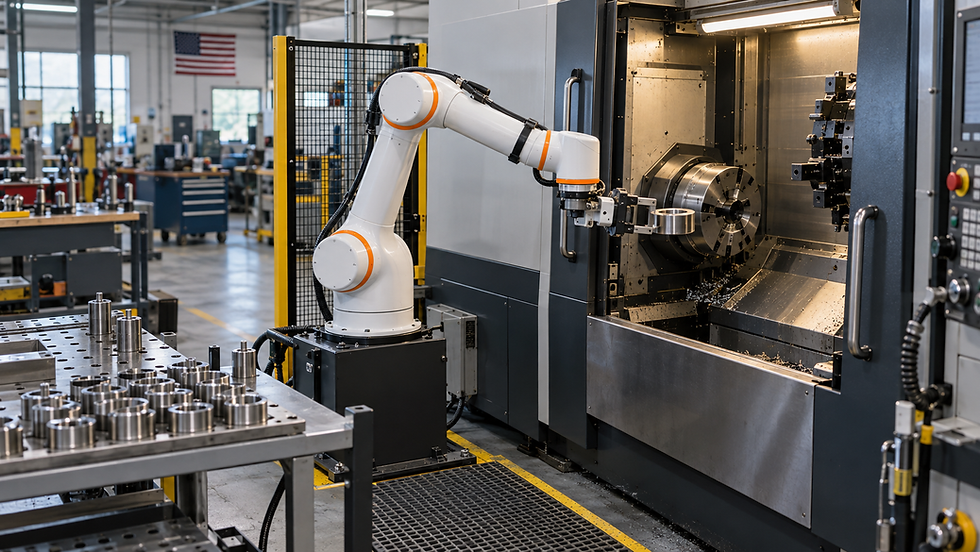
FAIRINO FR5 vs. Mitsubishi MELFA ASSISTA RV-5AS-D: Compact Cobot Value vs. Japanese Industrial Automation Engineering

The FAIRINO FR5 and Mitsubishi MELFA ASSISTA RV-5AS-D are compact six-axis collaborative robots designed for many of the same automation projects: machine tending, pick and place, light assembly, testing, inspection, packaging, dispensing, laboratory automation, and repetitive material handling. Their nominal payload and reach specifications are remarkably close. Both are 5 kg-class cobots, both reach approximately 0.9 meters, both publish a maximum composite speed of 1 m/s, and both can be deployed without the floor space normally associated with a large conventional industrial robot cell.
The similarities make this a useful comparison, but the two robots represent different purchasing philosophies.
The FAIRINO FR5 is a value-focused cobot with transparent U.S. pricing, a 5 kg nominal payload, a separately published 7 kg maximum payload, 922 mm reach, ±0.02 mm published pose repeatability, approximately 22 kg robot weight, flexible mounting, and an open development environment. FAIRINO USA publicly lists the FR5 at $7,999.
The Mitsubishi MELFA ASSISTA RV-5AS-D combines collaborative operation with Mitsubishi Electric's established factory-automation ecosystem. Mitsubishi publishes a 5 kg rated payload, a conditional 5.5 kg maximum payload, 910 mm reach, ±0.03 mm position repeatability, a 1,000 mm/s high-speed operating mode, IP54 protection, and 32 kg robot-arm mass. Mitsubishi does not show a simple official U.S. MSRP on the product page reviewed for this comparison. The public price used here is €31,000 excluding VAT from European automation marketplace Unchained Robotics, equal to approximately $35,935 at the ECB reference rate of 1 EUR = 1.1592 USD published for September 11, 2026.
This is therefore not merely a contest between two similar specification sheets. It is a choice between a lower-cost, lighter, developer-friendly cobot and a higher-priced platform that may create additional value when a factory already uses Mitsubishi PLCs, HMIs, networks, engineering tools, service channels, or MELFA robot infrastructure.
Quick Verdict
Choose the FAIRINO FR5 when your priorities are lower initial robot cost, slightly longer reach, stronger published repeatability, lower arm weight, any-orientation mounting, optional IP65 protection, public U.S. purchasing, and open integration through common programming languages, ROS, ROS 2, TCP/IP, Modbus, and optional industrial networks.
Choose the Mitsubishi MELFA ASSISTA RV-5AS-D when integration with Mitsubishi Electric factory automation, RT VisualBox workflow, a tactile button-based direct-teaching interface, a documented safety architecture, a standard/food or oil-mist configuration, or access to Mitsubishi's global industrial support ecosystem is more valuable than the lower robot purchase price.
For a buyer starting from a neutral automation environment, the FR5 offers the stronger capability-to-cost ratio. For a Mitsubishi-centered plant, the ASSISTA may reduce controls engineering, internal standardization effort, training fragmentation, and long-term support complexity enough to justify its premium.
Product Information
FAIRINO FR5 Product Information
Product field | Value |
Product name | FAIRINO FR5 Collaborative Robot |
Brand | FAIRINO |
Manufacturer | FAIRINO |
Model | FR5 |
SKU | FAIRINO-FR5 |
MPN | FR5 |
Product type | Six-axis collaborative industrial robot |
Category | Collaborative robots and compact industrial robotic arms |
Nominal payload | 5 kg |
Published maximum payload | 7 kg, subject to application limits |
Reach | 922 mm |
Pose repeatability | ±0.02 mm according to the current FAIRINO USA product page |
Typical TCP speed | 1 m/s |
Robot-arm weight | Approximately 22 kg |
Protection | IP54; IP65 optional |
Mounting | Any orientation |
Public price | $7,999 |
Currency | USD |
Seller | FAIRINO USA |
Official U.S. product and purchase URL | |
Manufacturer product URL | |
Primary image URL | |
Additional image URL |
FAIRINO USA lists the FR5 at $7,999 with 5 kg payload, 922 mm reach, and ±0.02 mm repeatability. Its detailed specification section lists 5 kg nominal payload and 7 kg maximum payload, six rotating joints, a 10.1-inch teach pendant or mobile-terminal Web App, 1 m/s typical TCP speed, IP54 protection with an IP65 option, any-orientation mounting, a 149 mm footprint, and approximately 22 kg arm weight.
The 7 kg figure should not be interpreted as an unrestricted continuous-duty rating. Every application must be validated for tool mass, workpiece mass, center of gravity, wrist moment, robot pose, speed, acceleration, cable forces, and duty cycle.
Mitsubishi MELFA ASSISTA RV-5AS-D Product Information
Product field | Value |
Product name | Mitsubishi MELFA ASSISTA RV-5AS-D Collaborative Robot |
Brand | Mitsubishi Electric |
Manufacturer | Mitsubishi Electric |
Model | RV-5AS-D |
SKU | MITSUBISHI-RV-5AS-D |
MPN / public part number | RV-5AS-D / 502852 |
Product type | Six-axis collaborative vertical articulated robot |
Category | Collaborative robots and industrial automation robots |
Rated payload | 5 kg |
Maximum payload | 5.5 kg under the condition stated by Mitsubishi |
Reach | 910 mm |
Position repeatability | ±0.03 mm |
Maximum composite speed | 1,000 mm/s in high-speed operation mode |
Standard collaborative speed | 250 mm/s |
Low-speed collaborative mode | 50 mm/s |
Robot-arm weight | 32 kg |
Protection | IP54 |
Installation | Floor or ceiling according to Mitsubishi's specification page |
Controller | CR800-05VD |
Public reseller price | €31,000 excluding VAT |
Indicative USD conversion | Approximately $35,935 at 1 EUR = 1.1592 USD |
Price source | Unchained Robotics public European listing |
Official product URL | |
Official catalog URL | |
Reseller offer URL | |
Primary image URL | |
Additional image URL |
Mitsubishi's specification page distinguishes between a 5 kg rated payload and a 5.5 kg maximum payload. The 5.5 kg maximum is allowed when the mechanical interface faces downward within ±10 degrees of vertical. For general comparison and application planning, 5 kg is therefore the responsible baseline. The extra 0.5 kg is conditional headroom rather than a universal operating rating.
FAIRINO FR5 vs. Mitsubishi MELFA ASSISTA Main Specification Comparison
Specification | FAIRINO FR5 | Mitsubishi MELFA ASSISTA RV-5AS-D | Practical advantage |
Axes | 6 | 6 | Tie |
Rated or nominal payload | 5 kg | 5 kg | Tie |
Published maximum payload | 7 kg, application-dependent | 5.5 kg with stated flange-orientation condition | FR5 on published headroom |
Reach | 922 mm | 910 mm | FR5 by 12 mm |
Repeatability | ±0.02 mm | ±0.03 mm | FR5 on published specification |
Maximum or typical TCP speed | 1 m/s typical | 1,000 mm/s high-speed mode | Equivalent headline value |
Collaborative-mode speed | Application and safety configuration dependent | 250 mm/s standard; 50 mm/s low-speed | Mitsubishi publishes clear mode values |
Robot-arm weight | Approximately 22 kg | 32 kg | FR5 by approximately 10 kg |
Protection | IP54; IP65 optional | IP54 | FR5 when IP65 is selected |
Mounting | Any orientation | Floor or ceiling on official specification page | FR5 on published mounting flexibility |
Tool mechanical-interface I/O | 2 inputs / 2 outputs plus analog I/O and high-speed pulse inputs | 2 inputs / 4 outputs | Depends on tool architecture |
Tool electrical supply | 24 V / 1.5 A | 24 V / 0.7 A through five-conductor line; separate interface details apply | FR5 on published current capacity |
Tool pneumatic routing | External integration as required | Two 6 mm primary and four 4 mm secondary hoses published | Mitsubishi |
Ethernet at arm | Integration-dependent | Cat-5e-supported LAN cable published | Mitsubishi |
Controller | FAIRINO mini controller | Mitsubishi CR800-05VD | Ecosystem-dependent |
Programming | Web App, pendant, graphical programming, drag teaching, SDKs | RT VisualBox, direct teaching, MELFA engineering ecosystem | Different strengths |
Developer access | C#, C++, Python, ROS, ROS 2 | Mitsubishi automation interfaces and engineering tools | FR5 for open development; Mitsubishi for plant standardization |
Standard environment | General industrial use | Standard/food variants; oil-mist specification documented | Mitsubishi for specialized variants |
Public numeric price | $7,999 | €31,000 excluding VAT | FR5 |
Price Comparison
Robot | Public numeric price | Source type | Important qualification |
FAIRINO FR5 | $7,999 | FAIRINO USA public listed price | Confirm package contents, freight, tax, tooling, and integration |
Mitsubishi MELFA ASSISTA RV-5AS-D | €31,000 excluding VAT | Unchained Robotics public reseller listing | Not Mitsubishi official MSRP; regional package, tax, freight, warranty, and support can differ |
Mitsubishi indicative USD conversion | Approximately $35,935 | €31,000 × 1.1592 USD per EUR | Comparison only, using the ECB reference rate dated September 11, 2026 |
Indicative converted price difference | Approximately $27,936 | $35,935 minus $7,999 | Robot listing comparison only; not a turnkey-cell quotation |
Mitsubishi converted-price multiple | Approximately 4.49× | $35,935 divided by $7,999 | Does not establish equal package content |
FR5 discount relative to converted Mitsubishi price | Approximately 77.7% lower | Based on the public prices and stated FX conversion | Excludes all integration and lifecycle costs |
Visible price disclosure: Mitsubishi Electric does not publish a simple official U.S. MSRP on the product page used for this comparison. Unchained Robotics lists the MELFA ASSISTA at €31,000 excluding VAT. At the European Central Bank reference rate of 1 EUR = 1.1592 USD for September 11, 2026, that equals approximately $35,935 for comparison only. This is a reseller market reference, not Mitsubishi's official global price, and it excludes VAT. Exchange rates, regional packages, shipping, duties, options, and support can change the final price.
The FR5's $7,999 figure is a public FAIRINO USA product-page price. Neither number should automatically be treated as a complete installed-cell price. Buyers should request written quotations specifying the robot arm, controller, safety hardware, pendant or programming device, cables, software, fieldbus licenses, shipping, duties, training, warranty, technical support, gripper, sensors, guarding, fixtures, machine interface, installation, and validation.
The price gap is large enough to influence project economics. At the stated conversion, a buyer could theoretically purchase four FR5 arms for less than the converted Mitsubishi reseller price, although four robots do not replace the engineering quality, support, accessories, software, or installed value of one complete application. The responsible conclusion is that FAIRINO leaves substantially more budget for tooling and integration, while Mitsubishi must justify its premium through ecosystem fit, engineering workflow, specialized configurations, supplier qualification, or lower organizational friction.
1. Payload Capacity and Wrist Load
Both robots are properly described as 5 kg-class cobots. The FR5 publishes 5 kg nominal payload and a separate 7 kg maximum. Mitsubishi publishes 5 kg rated payload and 5.5 kg maximum under a defined orientation condition.
Payload calculations must include everything attached to the flange. A 2.7 kg part, 1.2 kg gripper, 0.3 kg adapter, and 0.2 kg cable allowance create a total moving load of 4.4 kg. Both robots can potentially handle that load within their 5 kg baseline rating, subject to center-of-gravity and wrist-moment limits. A 4.2 kg workpiece with the same 1.7 kg of tooling produces 5.9 kg total. That is above the rated payload of both robots, within the FR5's published maximum, and above Mitsubishi's conditional 5.5 kg maximum. The FR5 may therefore be the more plausible candidate, but the application would still require formal load validation.
The maximum number is only one part of payload engineering. A long tool moves the center of gravity away from the flange and increases wrist moment. Fast accelerations add dynamic load. Hose bundles and dress packs can produce changing forces throughout the path. A robot that can lift a mass in one pose may not be approved to move it at full speed through every pose.
Payload Verdict
The rated comparison is a tie at 5 kg. The FR5 wins on published maximum-payload headroom, while Mitsubishi provides a particularly precise limitation for its 5.5 kg maximum. In both cases, design to the rated payload unless the manufacturer or integrator validates the exact higher-load application.
2. Reach and Real Work Envelope
The FR5 has 922 mm reach and the MELFA ASSISTA has 910 mm reach. The FR5 advantage is 12 mm, approximately 1.3% of Mitsubishi's reach. This is too small to determine most projects by itself, but it can provide useful margin at the far edge of a fixture or machine door.
Headline reach is not the same as a usable work envelope. A robot must reach the target with the required wrist orientation while avoiding singularities, joint limits, collisions, cables, gripper interference, and machine structures. Tool length can extend the TCP but can also increase moment and reduce access around obstacles. A pedestal can improve reach but consumes floor space and may worsen access elsewhere.
Mitsubishi specifies floor and ceiling installation for the compared RV-5AS-D page. FAIRINO publishes any-orientation mounting for the FR5. That broader mounting statement may be useful for wall-mounted cells, angled bases, overhead frames, or machines where the arm must approach from an unconventional direction. Any nonstandard mounting structure must be rigid enough to preserve repeatability and rated to handle the robot's static and dynamic loads.
Reach Verdict
The FR5 has a small numerical reach advantage and broader published mounting flexibility. For either robot, model the complete work envelope with the actual tool, part, fixture, and approach poses before purchase.
3. Repeatability, Accuracy, and Process Capability
FAIRINO publishes ±0.02 mm repeatability for the FR5. Mitsubishi publishes ±0.03 mm position repeatability for the RV-5AS-D. On the specification sheet, the FR5 has the advantage by 0.01 mm.
Repeatability is not the same as absolute accuracy. Repeatability measures how consistently a robot returns to a position under defined conditions. Absolute accuracy describes how closely the real robot reaches commanded coordinates in the world. A robot may return extremely consistently to a taught point while still needing calibration to match an offline simulation, CAD coordinate, vision coordinate system, or transferred program.
The complete process also includes fixture stiffness, TCP calibration, gripper compliance, part tolerance, thermal change, payload, speed, camera calibration, force-control settings, and the machine itself. A flexible mounting table can erase the apparent benefit of a 0.01 mm specification difference. Likewise, vision or touch sensing can compensate for part location variation that mechanical repeatability alone cannot solve.
For repeated placement into a stable fixture, dispensing along a taught path, presenting a part to a gauge, or moving an inspection sensor between known positions, the FR5's ±0.02 mm specification is attractive. Mitsubishi's ±0.03 mm remains a strong value for a collaborative robot and may be easier to standardize in plants already using MELFA systems and Mitsubishi engineering practices.
Repeatability Verdict
The FR5 wins the published repeatability comparison. Neither number guarantees final process capability; validate the complete cell against the actual tolerance and measurement method.
4. Speed, Collaborative Modes, and Throughput
Both robots publish a 1 m/s headline TCP or composite-speed value. FAIRINO describes 1 m/s as the FR5's typical TCP speed. Mitsubishi publishes 1,000 mm/s in high-speed operation mode, 250 mm/s in standard collaborative operation, and 50 mm/s in low-speed collaborative operation.
The Mitsubishi specification is valuable because it exposes the difference between high-speed motion and safety-limited collaborative modes. A cobot does not automatically run at its maximum catalog speed when people are nearby. The final permitted speed depends on the risk assessment, separation distance, tool, payload, contact hazards, safety configuration, and protective measures.
Real throughput depends on much more than maximum TCP speed. Acceleration, deceleration, joint coordination, path blending, payload, settling time, gripper actuation, camera exposure, PLC handshake, machine response, operator interaction, and safety stops can dominate the cycle. Short motions may never reach the maximum speed. A better fixture layout can save more time than a higher catalog speed.
The right test is a representative cycle using the actual tool mass, critical poses, I/O sequence, and safety mode. Measure sustainable production over an extended run rather than relying on a single unloaded demonstration.
Speed Verdict
The headline value is effectively tied at 1 m/s. Mitsubishi provides clearer published speed bands for high-speed and collaborative operation. Actual production performance must be established through simulation or a time study.
5. Robot Weight, Cell Structure, and Redeployment
The FR5 weighs approximately 22 kg; the Mitsubishi arm weighs 32 kg. The FR5 is therefore about 10 kg lighter, or roughly 31% lighter relative to the Mitsubishi arm.
Weight matters when a cobot is installed on a mobile cart, moved between workstations, mounted overhead, placed on a machine frame, or carried through a facility for demonstrations and training. A lighter arm can reduce cart size, frame cost, handling effort, and structural load. It can also make a multi-station redeployment strategy more practical.
The heavier Mitsubishi arm is not automatically a disadvantage. Mass can accompany robust industrial construction, and many installations are fixed permanently. A 10 kg difference may be irrelevant when the robot is bolted to a properly engineered steel pedestal. Buyers should compare stiffness, vibration behavior, cable routing, base dimensions, and structural requirements rather than treating weight alone as a quality metric.
For mobile deployment, neither robot should simply be placed on a wheeled table. The cart needs a low center of gravity, sufficient mass and stiffness, locking or docking features, cable management, repeatable location, and a risk assessment for motion and transport.
Weight Verdict
The FR5 wins for portability and lower structural load. Mitsubishi's additional mass is less important in a permanent fixed cell.
6. Programming and Operator Experience
The FR5 supports graphical programming, drag teaching, a 10.1-inch teach pendant or mobile-terminal Web App, and published development options including C#, C++, Python, ROS, and ROS 2. This breadth appeals to system integrators, researchers, machine builders, and manufacturers that want to connect robot motion to custom software, databases, vision systems, laboratory equipment, or higher-level production orchestration.
Mitsubishi positions MELFA ASSISTA around simple setup, direct teaching, and RT VisualBox. The arm includes an operating panel with buttons that support teaching and operation close to the robot. A user can guide the arm and record positions without moving repeatedly between the robot and a separate programming station. RT VisualBox provides a visual environment intended to make common automation sequences easier to construct.
Mitsubishi's deeper advantage is organizational when the plant already has Mitsubishi expertise. Controls engineers may already know Mitsubishi PLCs, network tools, HMIs, servo systems, and support channels. Standard spare-parts procedures, cybersecurity reviews, vendor qualification, purchasing contracts, and maintenance relationships may already exist. These factors rarely appear in a robot specification table, but they can materially reduce deployment friction.
FAIRINO's open tools may be more attractive when the project includes ROS-based research, a Python application, custom PC software, experimental sensing, or an integrator's reusable platform. Openness creates flexibility, but it also means the integrator is responsible for designing, documenting, and supporting the complete architecture.
Programming Verdict
Choose FAIRINO for open development breadth and custom integration. Choose Mitsubishi for a visual direct-teaching workflow and stronger alignment with a Mitsubishi-standardized factory.
7. I/O, Pneumatics, and Industrial Connectivity
Tool-side connectivity can determine whether a cell is elegant or filled with external cables. FAIRINO lists two digital inputs, two digital outputs, one analog input, one analog output, two high-speed pulse inputs, and 24 V / 1.5 A tool power. Mitsubishi lists two inputs and four outputs at the mechanical interface, additional I/O routing through the forearm and base, integrated pneumatic hoses, a five-conductor 24 V line, and a Cat-5e-supported LAN cable.
Mitsubishi's documented internal pneumatic and network routing is valuable for grippers, valves, sensors, and smart end effectors. It can reduce external dress-pack complexity. The correct interpretation still depends on the exact controller, safety extension unit, optional cards, connector kit, and region-specific package.
FAIRINO publishes TCP/IP and industrial integration support, with Modbus and optional network choices used across its ecosystem. Its developer interfaces can make the robot easy to connect to custom software. Mitsubishi's CR800 controller can fit naturally into industrial architectures using Mitsubishi control products and supported networks.
Counting I/O points is not enough. The integrator should create a signal list that includes gripper commands, part-present sensing, machine-ready signals, fault reset, door status, safety status, vacuum confirmation, tool-change confirmation, analog process values, and spare capacity. Check voltage, current, sourcing or sinking convention, response time, safety classification, connector availability, and cable length.
Connectivity Verdict
Mitsubishi has an advantage in documented arm-integrated routing and Mitsubishi ecosystem alignment. FAIRINO has an advantage for open software integration and higher published tool-power current. The winning platform depends on the actual I/O and network architecture.
8. Environmental Protection and Specialized Variants
The standard comparison places both arms at IP54, while FAIRINO offers an IP65 option for the FR5. IP54 provides limited protection against dust and water spray; IP65 provides stronger dust and water-jet protection. The exact option and complete assembly must be confirmed on the quotation.
Mitsubishi offers ASSISTA configurations for standard, food-related, and oil-mist environments. This can be important in facilities that require specific surface treatment, grease, corrosion resistance, hygiene procedures, or resistance to manufacturing contaminants. A specialized model should be selected from the beginning; a standard robot should not be assumed suitable for food contact, chemical cleaning, coolant spray, or oil mist merely because the general product family offers another variant.
IP ratings do not cover every environmental hazard. They do not automatically establish food-contact compliance, cleanroom suitability, explosion protection, chemical resistance, or permission for high-pressure washdown. Cables, connectors, controller, safety unit, gripper, camera, and tool may have lower ratings than the arm.
Environmental Verdict
The optional IP65 FR5 is attractive when higher ingress protection is the central requirement. Mitsubishi is attractive when a documented food or oil-mist variant matches a plant's standardized environmental needs.
9. Safety Architecture and Collaborative Deployment
Mitsubishi publishes safety functions for ASSISTA including torque monitoring, speed monitoring, position monitoring, and safety I/O through its safety extension architecture. Its catalog identifies SIL 2 and PL d / Category 3 values for specified safety functions. The official speed table also distinguishes high-speed, standard collaborative, and low-speed collaborative operation.
FAIRINO positions the FR5 as a collaborative robot with collision detection and provides safety documentation and certificates through its product ecosystem. Buyers should request the exact declaration, certificate, safety manual, controller version, and firmware documentation for the unit being purchased.
No cobot is automatically safe in every application. The completed machine must be risk assessed. The assessment must consider the tool, part, speed, force, stopping distance, sharp edges, hot surfaces, trapping points, stored energy, unexpected startup, machine hazards, operator behavior, maintenance access, and foreseeable misuse.
A collaborative arm carrying a sharp component, welding torch, spinning cutter, hot part, or heavy gripper may still require guarding. Power-and-force-limited operation, speed-and-separation monitoring, hand guiding, and safety-rated monitored stop are application strategies, not marketing labels. The final solution may use scanners, mats, interlocks, fencing, reduced-speed zones, or other safeguards.
Safety Verdict
Mitsubishi provides an especially detailed public presentation of ASSISTA safety modes and functions. Both robots require a complete application-level risk assessment, safety validation, and documentation by qualified personnel.
10. Controller and Factory-Automation Ecosystem
The Mitsubishi RV-5AS-D connects to the CR800-05VD controller. The controller family ties the cobot to MELFA engineering, Mitsubishi networks, factory-automation products, and a global service organization. This is the ASSISTA's most important strategic advantage.
In an established plant, the value of a robot extends beyond its motion specifications. Maintenance technicians need diagnostic tools. Controls engineers need reusable code and approved network patterns. Purchasing needs known suppliers. IT and cybersecurity teams need documented interfaces. Operators need consistent training. Management needs predictable support and spare parts. A Mitsubishi-centered plant may place a high value on keeping these systems within one vendor ecosystem.
The FAIRINO FR5 uses FAIRINO's controller and open platform. This can reduce acquisition cost and allow an integrator to select best-of-breed external components. It may also avoid locking an application into one automation vendor. For smaller manufacturers, research groups, education, startups, and independent machine builders, that flexibility can be more valuable than alignment with a large installed base.
The tradeoff is ownership of integration. A modular system can be excellent, but someone must maintain the software versions, libraries, network configuration, backups, documentation, and compatibility between components.
Ecosystem Verdict
Mitsubishi wins when existing factory standards and supplier relationships matter. FAIRINO wins when low cost, flexibility, and open customization matter more than single-vendor alignment.
11. Application-by-Application Comparison
CNC and Machine Tending
The FR5's lower price, lighter weight, 922 mm reach, ±0.02 mm repeatability, and optional IP65 protection make it a strong candidate for compact machine tending. It leaves more project budget for a gripper, machine interface, pedestal, guarding, and chip or coolant protection.
The MELFA ASSISTA is attractive in a Mitsubishi-controlled cell, especially where the plant values a consistent controls architecture or selects an oil-mist configuration. Its internal hose and cable routing may simplify the tool package.
Winner: FR5 for capital efficiency; Mitsubishi for ecosystem alignment and specialized configuration.
Pick and Place
Both robots have the same 5 kg rated payload class and nearly identical reach and headline speed. The FR5 has slightly stronger repeatability and lower mass. Mitsubishi offers visual programming and direct teaching that may make simple sequences accessible to plant personnel.
The application should be tested with the real gripper and product. Vacuum systems, compliant fingers, conveyor tracking, vision latency, and part presentation often determine performance more than the arm specification.
Winner: FR5 for value; Mitsubishi when RT VisualBox or Mitsubishi controls shorten deployment.
Assembly and Screwdriving
The FR5's published repeatability is favorable for taught-point assembly and screw locations. Its SDK options are useful for custom fastening logic, torque data collection, and traceability.
The Mitsubishi platform can be compelling when the station uses Mitsubishi PLCs, HMIs, or factory databases. Integrated pneumatic routing and tool I/O may simplify screwdriver or gripper installation.
Winner: Application-dependent; FR5 on robot specification and price, Mitsubishi on plant integration.
Inspection and Testing
Neither comparison model should be assumed to include a complete vision system in its base price. Both can carry cameras, probes, barcode readers, electrical test tools, or other sensors. The FR5's lower cost leaves budget for specialized optics and lighting. Mitsubishi's automation ecosystem may simplify deterministic test sequencing and data exchange in an existing Mitsubishi plant.
Repeatability is helpful, but inspection performance depends on sensor quality, calibration, lighting, image processing, fixture variation, and traceability software.
Winner: FR5 for a custom cost-controlled inspection cell; Mitsubishi for a standardized Mitsubishi automation environment.
Food and Clean Applications
Mitsubishi explicitly offers standard/food variants within the ASSISTA family and emphasizes smooth, cleanable design. That gives it an advantage when a properly specified food-oriented configuration meets the application's requirements.
The FR5's optional IP65 rating may help in environments requiring stronger ingress protection, but IP65 alone is not proof of food-contact suitability. Materials, lubricants, surface finish, cleaning chemicals, and certification must be verified.
Winner: Mitsubishi when the correct food configuration is specified and validated.
Education and Research
The FR5's $7,999 public price, Python, C++, C#, ROS, and ROS 2 support make it highly attractive for universities, vocational programs, robotics laboratories, and applied research. More of the budget can go to tooling, sensors, mobile bases, and student stations.
Mitsubishi may be preferable when the program teaches industrial automation using Mitsubishi equipment or when students need exposure to a major global factory-automation ecosystem.
Winner: FR5 for affordability and open development; Mitsubishi for Mitsubishi-specific workforce training.
Mobile Cobot Stations
At approximately 22 kg, the FR5 is easier to integrate on a mobile cart than the 32 kg Mitsubishi arm. The lighter robot can reduce total cart mass and structural requirements.
Mitsubishi documents mobile use possibilities in its ASSISTA materials, including configurations associated with AGVs and AMRs. A complete mobile application needs docking accuracy, localization, power management, safe navigation, communication, and a stable working base.
Winner: FR5 on arm weight and acquisition cost; Mitsubishi when its documented mobile ecosystem fits the project.
12. Total Cost of Ownership
The robot price is only the first line in an automation budget. A complete cell may include:
Robot arm and controller
Teach device or programming software
Gripper, vacuum system, or process tool
Tool changer and adapter plates
Vision, lighting, sensors, and calibration targets
Pedestal, cart, frame, or overhead structure
Fixtures and part presentation
PLC, HMI, remote I/O, and network hardware
Safety scanner, interlocks, guarding, mats, or fencing
Machine interface and electrical cabinet work
Software development and commissioning
Risk assessment and safety validation
Training, documentation, backups, and spare parts
Freight, tax, duties, travel, and installation
Preventive maintenance and future changeovers
The FR5's public robot price is approximately $27,936 below the converted Mitsubishi reseller price at the stated ECB rate. That difference can fund a substantial portion of tooling and integration. For cost-sensitive first automation projects or multi-robot rollouts, the effect on capital approval and payback can be decisive.
However, purchase price is not the same as total cost of ownership. If a Mitsubishi-standardized plant can deploy ASSISTA significantly faster, reuse approved controls code, reduce training, obtain preferred support, and maintain one vendor architecture, some of the price premium may be recovered. Downtime, internal engineering hours, spare-parts policy, software maintenance, and supplier response can outweigh the arm price over several years.
A fair ROI model should use the same scope for both alternatives. Include realistic engineering hours, expected availability, cycle time, labor savings, scrap reduction, changeover time, maintenance, training, energy, finance cost, and residual value. Use sensitivity analysis instead of a single optimistic payback number.
TCO Verdict
The FR5 is the clear acquisition-cost winner and will often provide the faster payback from a neutral starting point. Mitsubishi can be economically rational when ecosystem standardization materially reduces engineering and operational cost.
13. Strengths and Limitations
FAIRINO FR5 Strengths
Public U.S. price of $7,999
5 kg nominal payload with 7 kg published maximum headroom
922 mm reach
±0.02 mm published repeatability
Approximately 22 kg arm weight
Any-orientation mounting
IP54 with optional IP65 protection
Graphical programming and drag teaching
C#, C++, Python, ROS, and ROS 2 development paths
Strong capability-to-cost ratio
FAIRINO FR5 Limitations
Smaller installed base and ecosystem than Mitsubishi Electric
Open integration may place more architecture and support responsibility on the integrator
The 7 kg maximum requires application-specific validation
Specialized food, clean, or oil-mist suitability must be confirmed by exact model and documentation
Local support depth can vary by geography and partner
Mitsubishi MELFA ASSISTA Strengths
Mitsubishi Electric factory-automation ecosystem
5 kg rated payload and conditional 5.5 kg maximum
910 mm reach and ±0.03 mm repeatability
Clearly published high-speed and collaborative speed modes
RT VisualBox and direct-teaching controls
CR800 controller platform
Integrated pneumatic, electrical, and Ethernet routing
Standard, food-related, and oil-mist configurations
Detailed public safety architecture
Global industrial brand and support network
Mitsubishi MELFA ASSISTA Limitations
Significantly higher public reseller pricing
32 kg arm is approximately 10 kg heavier than the FR5
Official specification page lists floor and ceiling mounting rather than any orientation
Conditional 5.5 kg maximum is well below the FR5's published 7 kg maximum
Final package, software, and option pricing may require distributor consultation
Final Decision Matrix
Buyer priority | Recommended robot | Why |
Lowest public acquisition price | FAIRINO FR5 | $7,999 versus €31,000 excluding VAT, approximately $35,935 at the stated ECB rate |
Strongest published repeatability | FAIRINO FR5 | ±0.02 mm versus ±0.03 mm |
Slightly longer reach | FAIRINO FR5 | 922 mm versus 910 mm |
Lowest robot-arm weight | FAIRINO FR5 | Approximately 22 kg versus 32 kg |
Highest published payload headroom | FAIRINO FR5 | 7 kg maximum published versus conditional 5.5 kg |
Any-orientation mounting | FAIRINO FR5 | Explicitly published by FAIRINO |
Open programming and ROS development | FAIRINO FR5 | Published C#, C++, Python, ROS, and ROS 2 support |
Mitsubishi PLC and factory ecosystem | Mitsubishi ASSISTA | Natural alignment with Mitsubishi automation architecture |
Direct-teaching buttons and RT VisualBox | Mitsubishi ASSISTA | Core user-experience strengths |
Published collaborative speed modes | Mitsubishi ASSISTA | 250 mm/s standard and 50 mm/s low-speed values are stated |
Integrated pneumatic and LAN routing | Mitsubishi ASSISTA | Detailed routing is published in the specification |
Food or oil-mist configuration | Mitsubishi ASSISTA | Specialized variants are documented |
Neutral-site capability per dollar | FAIRINO FR5 | Similar core performance at much lower public robot price |
Final Verdict
The FAIRINO FR5 is the stronger overall value for most buyers comparing the robots from a neutral starting point. It matches Mitsubishi's 5 kg rated payload class, reaches 12 mm farther, publishes stronger repeatability, weighs approximately 10 kg less, offers broader stated mounting flexibility, provides optional IP65 protection, and supports open development tools. Most importantly, its public U.S. price of $7,999 is approximately $27,936 lower than the converted Mitsubishi reseller price of approximately $35,935, based on the stated ECB reference rate.
The Mitsubishi MELFA ASSISTA RV-5AS-D should not be dismissed as an expensive equivalent. Its real value is the combination of collaborative robotics with Mitsubishi Electric's industrial controls ecosystem. RT VisualBox, direct-teaching controls, the CR800 controller, integrated pneumatic and network routing, clearly documented collaborative speed modes, detailed safety functions, specialized environmental variants, and global factory-automation support can make it the better engineering decision in the right plant.
The practical recommendation is simple:
Select the FR5 when budget, open integration, portability, repeatability, payload headroom, and fast ROI are the dominant requirements.
Select the MELFA ASSISTA when Mitsubishi standardization, environmental configuration, documented safety architecture, and long-term single-vendor alignment are worth the premium.
Before purchasing either robot, test the real application with the actual tool and part, validate every critical pose, request a complete itemized quotation, confirm regional support, and complete a formal safety assessment.
Frequently Asked Questions
Is the FAIRINO FR5 cheaper than the Mitsubishi MELFA ASSISTA RV-5AS-D?
Yes, based on the public listings reviewed. FAIRINO USA lists the FR5 at $7,999. Unchained Robotics lists the Mitsubishi RV-5AS-D at €31,000 excluding VAT, approximately $35,935 at the stated ECB rate. The indicative converted difference is approximately $27,936. These figures are not guaranteed to include identical equipment or services.
Which robot has more payload?
Both have a 5 kg baseline rating. FAIRINO publishes a 7 kg maximum for the FR5, subject to application limits. Mitsubishi publishes a 5.5 kg maximum only when the mechanical interface faces downward within ±10 degrees of vertical. The FR5 has more stated maximum headroom, but either higher-load condition must be validated.
Which cobot has longer reach?
The FAIRINO FR5 reaches 922 mm. The Mitsubishi MELFA ASSISTA reaches 910 mm. The FR5 is longer by 12 mm, a modest difference that may still help near the edge of a workstation.
Which robot is more repeatable?
The FR5 publishes ±0.02 mm repeatability, while Mitsubishi publishes ±0.03 mm for the RV-5AS-D. The FR5 has the stronger catalog value. Final process accuracy depends on the complete cell, calibration, tooling, fixtures, payload, temperature, and sensing.
Are both robots equally fast?
Their headline linear speed is effectively equal at 1 m/s. FAIRINO calls this a typical TCP speed. Mitsubishi specifies 1,000 mm/s in high-speed mode, 250 mm/s in standard collaborative operation, and 50 mm/s in low-speed collaborative operation. Real cycle time depends on the programmed path and safety configuration.
Which robot is easier to program?
It depends on the user. FAIRINO offers graphical programming, drag teaching, a Web App, and SDK paths including Python, C++, C#, ROS, and ROS 2. Mitsubishi offers RT VisualBox, direct teaching, arm-mounted operating buttons, and integration with the MELFA and Mitsubishi automation ecosystem.
Which robot is better for a Mitsubishi PLC factory?
The MELFA ASSISTA is usually the more natural strategic fit because it belongs to Mitsubishi Electric's broader factory-automation platform. The FR5 may still integrate through standard networks and I/O, but the plant should compare engineering effort, support, reusable code, cybersecurity approval, and maintenance standards.
Which robot is better for mobile or frequently redeployed stations?
The FR5 has an advantage because its arm weighs approximately 22 kg compared with 32 kg for Mitsubishi. Mitsubishi also documents mobile applications with AGV and AMR concepts, so the final decision depends on the complete cart, docking, localization, power, and safety design.
Can either robot work without safety fencing?
Possibly, but not automatically. The complete application must be risk assessed. The tool, part, speed, force, crushing points, sharp edges, heat, machine hazards, and operator access may require scanners, interlocks, guarding, or fencing even when the robot arm is collaborative.
Which robot offers better ROI?
The FR5 will often produce faster payback because its public robot price is much lower. The Mitsubishi can still deliver better total economics in a plant where vendor standardization reduces integration time, training, spare-parts complexity, or downtime. ROI should be calculated from complete installed cost and realistic operating assumptions.
Source and Pricing Notes
FAIRINO FR5 specifications and price: https://www.fairino.us/collaborative-robot/fairino/fr5
FAIRINO manufacturer FR5 specifications: https://fairino.com/FR/4.html
Mitsubishi official RV-5AS-D specifications: https://www.mitsubishielectric.com/fa/products/faspec/detail.page?category=ex&formNm=RV-5AS-D&id=spec&kisyu=%2Frobot&lang=2
Mitsubishi MELFA ASSISTA official catalog: https://www.mitsubishielectric.com/dl/fa/document/catalog/robot/l%28na%29-09104eng/I09104b.pdf
Mitsubishi public reseller price: https://unchainedrobotics.de/en/products/robot/cobot/mitsubishi-melfa-assista-rv-5as-d
ECB euro reference exchange rates: https://www.ecb.europa.eu/stats/policy_and_exchange_rates/euro_reference_exchange_rates/html/index.en.html
Prices, availability, specifications, packages, and URLs can change. Confirm all commercial and technical information before purchase or publication.