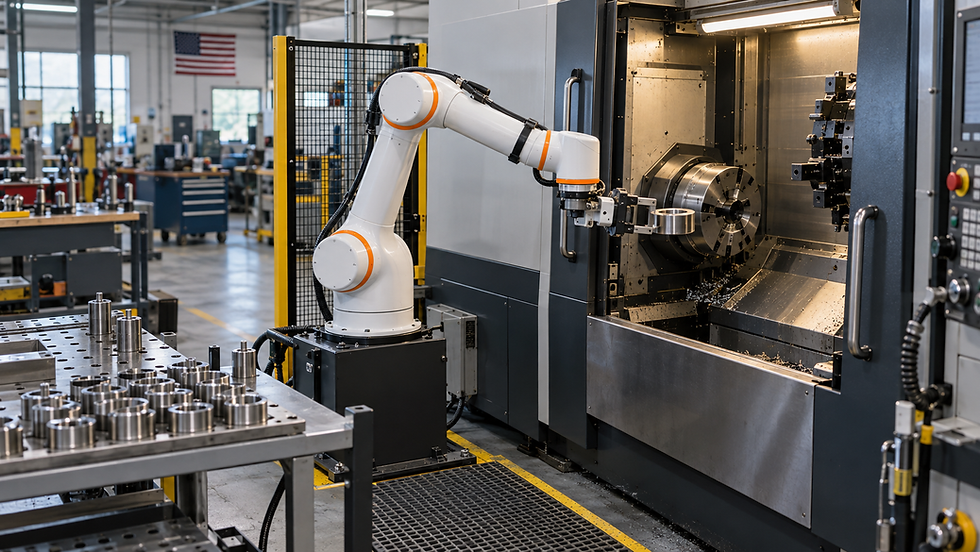
FAIRINO FR5 vs. OMRON TM5-900: 5 kg Cobot Value vs. Built-In Vision Cobot Engineering

The FAIRINO FR5 and OMRON TM5-900 are compact six-axis collaborative robots aimed at many of the same automation projects: machine tending, pick and place, inspection, light assembly, packaging, dispensing, testing, and repetitive material handling. They occupy a similar physical class, have nearly identical reach, and can be installed on a table, wall, or other suitable structure. However, they approach the automation problem from very different commercial and technical directions.
The FAIRINO FR5 emphasizes payload-per-dollar, high published repeatability, open integration options, flexible mounting, and transparent U.S. pricing. FAIRINO USA lists the FR5 at $7,999, with a 5 kg nominal payload, a published 7 kg maximum payload, 922 mm reach, and ±0.02 mm pose repeatability.
The OMRON TM5-900 emphasizes integrated machine vision, TMflow graphical programming, a mature industrial-automation brand, ISO Class 3 cleanroom compatibility, and a higher published average speed. It has a 4 kg maximum payload, 900 mm reach, ±0.05 mm repeatability, and a 5 MP color camera on the vision-equipped model. OMRON does not publish a simple U.S. MSRP on its product page, but Unchained Robotics publicly lists the TM5-900 at €30,320 excluding VAT.
One naming point must be made clear from the beginning: despite the “TM5” name, the current OMRON specification for the TM5-900 is 4 kg, not 5 kg. The shorter-reach TM5-700 is the member of this product family rated for 6 kg. Therefore, this is a close compact-cobot comparison rather than a perfectly equal payload comparison.
Quick Verdict
Choose the FAIRINO FR5 when the primary goals are lower initial robot cost, a full 5 kg nominal payload, slightly longer reach, stronger published repeatability, optional IP65 protection, and an open integration environment with Python, C++, C#, ROS, and ROS 2 support.
Choose the OMRON TM5-900 when built-in vision, faster published motion, ISO Class 3 cleanroom compatibility, four digital inputs and four digital outputs at the tool, TMflow programming, or alignment with an existing OMRON automation environment creates enough operational value to justify the higher public reseller price.
The FR5 is the stronger hardware-value proposition. The TM5-900 can be the better application platform when integrated vision and OMRON’s ecosystem reduce engineering time, simplify inspection, or make frequent product changeovers easier.
Product Information
FAIRINO FR5 Product Information
Product field | Value |
Product name | FAIRINO FR5 Collaborative Robot |
Brand | FAIRINO |
Manufacturer | FAIRINO |
Model | FR5 |
SKU | FAIRINO-FR5 |
MPN | FR5 |
Product type | Six-axis collaborative industrial robot |
Category | Collaborative robots and compact industrial robotic arms |
Nominal payload | 5 kg |
Published maximum payload | 7 kg, subject to application limits |
Reach | 922 mm |
Pose repeatability | ±0.02 mm according to ISO 9283 |
Typical TCP speed | 1 m/s |
Robot-arm weight | Approximately 22 kg |
Standard protection | IP54 |
Optional protection | IP65 |
Mounting | Any orientation |
Public price | $7,999 |
Currency | USD |
Seller | FAIRINO USA |
Official U.S. product URL | |
Manufacturer product URL | |
Primary image URL | |
Additional image URL |
FAIRINO’s official specification page publishes the FR5 at 5 kg nominal payload, 7 kg maximum payload, 922 mm reach, and ±0.02 mm pose repeatability. FAIRINO USA publicly lists the robot at $7,999. The application must still be checked against center of gravity, tool mass, moment, duty cycle, speed, and the manufacturer’s load diagrams; a published maximum figure should not be treated as an unrestricted continuous payload rating.
OMRON TM5-900 Product Information
Product field | Value |
Product name | OMRON TM5-900 Collaborative Robot |
Brand | OMRON |
Manufacturer | OMRON / Techman Robot platform |
Model | TM5-900 |
SKU | OMRON-TM5-900 |
Example OMRON order number | RT6-0009001; configuration-specific numbers vary |
Product type | Six-axis collaborative robot with integrated vision |
Category | Collaborative robots and vision-enabled automation robots |
Maximum payload | 4 kg |
Reach | 900 mm |
Repeatability | ±0.05 mm |
Average speed | 1.4 m/s |
Robot-arm weight | 22.6 kg for the AC configuration |
Protection | IP54 robot arm, IP32 controller, IP40 robot stick |
Cleanroom rating | ISO Class 3 |
Integrated camera | 5 MP color camera on the vision-equipped TM5-900 |
Mounting | Table, wall, or ceiling |
Public reseller price | €30,320 excluding VAT |
Currency | EUR |
Price source | Unchained Robotics public reseller listing |
Official product URL | |
Official OMRON specification URL | |
Reseller price URL | |
Primary image URL | |
Additional image URL |
OMRON’s official product page lists the TM5-900 with 4 kg maximum payload, 900 mm reach, ±0.05 mm repeatability, 1.4 m/s average speed, IP54 arm protection, and ISO Class 3 cleanroom compatibility. Its integrated 5 MP color camera and TMflow programming environment are among its most important differentiators.
FAIRINO FR5 vs. OMRON TM5-900 Main Specification Comparison
Specification | FAIRINO FR5 | OMRON TM5-900 | Practical advantage |
Axes | 6 | 6 | Tie |
Nominal or maximum payload | 5 kg nominal; 7 kg published maximum | 4 kg maximum | FR5 |
Reach | 922 mm | 900 mm | FR5 by 22 mm |
Repeatability | ±0.02 mm | ±0.05 mm | FR5 on published specification |
Published TCP/average speed | 1 m/s typical TCP speed | 1.4 m/s average speed | TM5-900 on headline speed |
Main joint speeds | Up to 180°/s on all axes | 180°/s on J1–J3; 225°/s on J4–J6 | TM5-900 at the wrist |
Robot weight | Approximately 22 kg | 22.6 kg AC; 22.3 kg DC | Nearly equal |
Arm protection | IP54; IP65 optional | IP54 | FR5 when IP65 option is selected |
Controller protection | IP54 mini controller | IP32 | FR5 on published rating |
Cleanroom classification | Not stated as standard on the compared page | ISO Class 3 | TM5-900 |
Mounting | Any orientation | Table, wall, ceiling | Functionally similar |
Tool digital I/O | 2 DI, 2 DO | 4 DI, 4 DO | TM5-900 |
Tool analog I/O | 1 AI, 1 AO | 1 AI, no AO | Depends on tool; FR5 has analog output |
Tool power | 24 V / 1.5 A | 24 VDC / 1.5 A | Tie |
Control-box digital I/O | 16 DI, 16 DO | 16 DI, 16 DO | Tie |
Control-box analog I/O | 2 AI, 2 AO | 2 AI, 1 AO in OMRON’s current table | FR5 on published analog output count |
Standard communication | I/O, TCP/IP, Modbus TCP/RTU | RS-232, Ethernet, Modbus TCP/RTU | Comparable core connectivity |
Optional industrial networks | CC-Link, PROFINET, EtherNet/IP, EtherCAT | PROFINET and EtherNet/IP options | FR5 lists more optional networks |
Software/developer access | Web App, pendant, C#, C++, Python, ROS, ROS 2 | TMflow graphical environment; industrial interfaces | Different strengths |
Built-in vision | External vision can be integrated | 5 MP color camera built in | TM5-900 |
Public robot price | $7,999 | €30,320 excluding VAT | FR5 |
Price Comparison
Robot | Public numeric price | Source type | Important qualification |
FAIRINO FR5 | $7,999 | FAIRINO USA public listed price | Robot-page price; confirm package contents, freight, tax, tooling, and integration |
OMRON TM5-900 | €30,320 excluding VAT | Unchained Robotics public reseller price | Not presented as OMRON official MSRP; distributor and regional pricing can vary |
OMRON TM5-900 indicative USD conversion | Approximately $35,147 | €30,320 × 1.1592 USD per EUR | Comparison conversion only, based on the ECB reference rate dated September 11, 2026 |
Indicative converted price gap | Approximately $27,148 | Converted reseller price minus FR5 list price | Not a quotation and excludes taxes, freight, options, tooling, and integration |
Visible price disclosure: OMRON does not publish a simple official MSRP for the TM5-900 on the product page reviewed for this comparison. This article uses Unchained Robotics’ public reseller price of €30,320 excluding VAT. Using the European Central Bank reference rate of 1 EUR = 1.1592 USD on September 11, 2026, that equals approximately $35,147 for comparison only. Final pricing may vary by country, distributor, configuration, cable length, hardware version, software options, shipping, tax, support, warranty, and integration package.
The numeric price gap is substantial, but the two numbers should not be interpreted as identical package quotations. The FR5 price comes from the FAIRINO USA robot product page. The OMRON figure comes from a European reseller and excludes VAT. A buyer should request written quotations defining exactly what is included: robot arm, controller, robot stick or pendant, cables, vision hardware, software licenses, fieldbus options, training, delivery, installation, risk assessment, tooling, and warranty support.
Even after allowing for package differences, the published numbers position the FR5 as the lower-capital-cost option. The TM5-900 must therefore create value through features such as its integrated camera, TMflow environment, faster motion, cleanroom rating, additional tool-side digital I/O, and OMRON ecosystem.
1. Payload Capacity: 5 kg Versus 4 kg
Payload is the first major difference. The FR5 has a 5 kg nominal payload and a separately stated 7 kg maximum. The OMRON TM5-900 is officially specified for a maximum payload of 4 kg.
That 1 kg difference between the normal 5 kg FR5 rating and the TM5-900 maximum is commercially meaningful. Payload must include every moving item attached to the flange: gripper, fingers, vacuum generator, tool changer, camera, force sensor, cable bracket, adapter plate, process tool, and the workpiece itself.
Consider a machine-tending project with a 2.8 kg component, 1.0 kg gripper, and 0.4 kg adapter and cabling allowance. The total moving payload is 4.2 kg. That exceeds the TM5-900’s published 4 kg maximum before a safety or design margin is considered, while it remains inside the FR5’s 5 kg nominal rating. In this case, the FR5 is the more natural selection.
For a lighter electronics application with a 0.5 kg part and a 0.8 kg electric gripper, both robots have comfortable payload capacity. The decision can then focus on vision, precision, software, cycle time, cleanliness, and price.
The FR5’s published 7 kg maximum should be handled responsibly. It is useful evidence of additional capability, but an integrator should not assume every trajectory, speed, orientation, center-of-gravity position, or duty cycle is approved at 7 kg. The exact application must be validated through FAIRINO’s technical documentation and load limits.
Payload Verdict
The FR5 wins the payload comparison. It offers 25% more nominal payload than the TM5-900’s 4 kg maximum, before considering FAIRINO’s separately published 7 kg maximum figure.
2. Reach and Work Envelope
The FR5 reaches 922 mm, while the TM5-900 reaches 900 mm. The difference is 22 mm, or approximately 2.4% relative to the OMRON reach.
This is not a large difference. Both robots belong to the same approximate reach class and can often serve the same compact workstation. Nevertheless, 22 mm can matter near the boundary of a machine opening, tray, fixture, or inspection station. A slightly longer arm may eliminate the need for a tool extension or allow a pedestal to sit farther from a machine door.
Headline reach is not the complete work envelope. Joint limits, wrist orientation, collision zones, singularities, tool length, cable routing, and the required approach angle affect whether the robot can reach a real point with a usable pose. The correct engineering method is to model the complete cell or test the critical poses with the actual tool and part.
Reach Verdict
The FR5 has a small objective advantage at 922 mm versus 900 mm. The difference is unlikely to decide most projects by itself, but it adds useful margin in a tight cell.
3. Repeatability and Process Accuracy
The FR5 publishes ±0.02 mm pose repeatability according to ISO 9283. OMRON publishes ±0.05 mm repeatability for the TM5-900. On the specification sheet, the FR5 therefore has the stronger repeatability figure.
Repeatability describes how consistently a robot returns to a taught position under specified test conditions. It is not the same as absolute accuracy. A robot can return precisely to a taught point while still requiring calibration or compensation to reach coordinates imported from a CAD model. Real process performance is also affected by fixture variation, tool deflection, camera calibration, thermal conditions, part tolerance, TCP definition, payload, speed, and the stiffness of the workstation.
For taught-point operations such as loading a stable fixture, dispensing along a taught path, positioning an inspection camera, or repeatedly presenting a part, lower repeatability deviation can be valuable. The FR5’s ±0.02 mm figure is attractive for a value-priced cobot.
The TM5-900’s integrated vision can compensate for variation that a repeatability number alone cannot solve. If parts arrive in slightly different positions, a camera can locate them and modify the robot target. In this scenario, the OMRON platform may deliver a more robust total process even though its published mechanical repeatability is ±0.05 mm rather than ±0.02 mm.
Repeatability Verdict
The FR5 wins on the published mechanical repeatability number. The TM5-900 can regain an application-level advantage when built-in vision is used to correct variable part location or support inspection.
4. Speed and Cycle-Time Potential
FAIRINO lists a typical TCP speed of 1 m/s for the FR5 and maximum joint speed of 180°/s across all six axes. OMRON lists an average speed of 1.4 m/s for the TM5-900, with 180°/s on the first three joints and 225°/s on wrist joints four through six.
The OMRON therefore has the stronger headline speed specifications. Faster wrist motion can help when the task requires frequent reorientation, such as turning parts between inspection views, changing tool angle, or presenting multiple faces of a component.
Cycle time cannot be predicted from one speed number. Collaborative operating limits, path length, acceleration, payload, tool geometry, settling time, camera exposure, PLC handshake, gripper action, machine response, and safety configuration may dominate the real cycle. A robot capable of higher speed may still operate slowly when humans share the workspace. Conversely, a well-designed fixture can reduce travel far more effectively than a modest increase in robot speed.
Speed Verdict
The TM5-900 wins on published average speed and wrist-joint speed. A time study or simulation is still required to quantify production throughput.
5. Built-In Vision Versus Open Integration
Vision is the TM5-900’s clearest functional differentiator. The vision-equipped model includes a 5 MP color camera, and OMRON promotes object recognition, positioning, visual servoing, inspection, and landmark-based relocation. Landmarks can help a robot recognize its position relative to a workstation after redeployment, reducing the recalibration burden in appropriate applications.
This architecture is attractive for manufacturers that need to inspect components, read visual features, locate variable parts, or move a cobot between workstations. Combining camera functions and robot programming in one environment may reduce the number of separate components and software interfaces an integrator must manage.
The FR5 does not claim an equivalent camera as a standard built-in feature on the compared product page. Its strength is the ability to integrate with a wider automation stack through controller I/O, TCP/IP, Modbus TCP/RTU, optional industrial networks, and software development kits for C#, C++, Python, ROS, and ROS 2. External cameras, force sensors, PLCs, and custom applications can be integrated according to project requirements.
The commercial choice is therefore not simply “vision versus no vision.” It is an integrated vision workflow versus a more modular integration approach. Integrated vision may shorten engineering time for supported workflows. A modular architecture may give a system integrator more freedom to choose camera resolution, lens, lighting, 2D or 3D sensing, inference hardware, and software.
Vision and Integration Verdict
The TM5-900 wins when built-in vision and TMflow directly solve the application. The FR5 is compelling when the cell requires custom software, external vision, ROS-based development, or a lower-cost robot at the center of a tailored system.
6. Programming and User Experience
The FR5 can be programmed through a 10.1-inch teach pendant or a mobile-terminal Web App. FAIRINO also publishes SDK support for C#, C++, Python, ROS, and ROS 2. This is useful for integrators, research teams, machine builders, and companies that want to connect the cobot to custom software or higher-level orchestration.
OMRON’s TMflow is a flowchart-based graphical environment designed to make robot programming accessible. Hand guiding and buttons on the arm support quick position teaching. The close connection between robot motion and built-in vision is an important advantage for users who want to create camera-guided tasks without assembling an entirely separate software stack.
Neither approach is universally better. A plant technician may prefer a visual flowchart and integrated camera tools. A developer may prefer Python or ROS access. A machine builder may prioritize fieldbus support and reusable templates. The best evaluation is to ask the people who will maintain the cell to program a representative task during a demonstration.
Programming Verdict
OMRON has the advantage for an integrated low-code vision workflow. FAIRINO has the advantage for published developer-language breadth and open customization.
7. I/O, Networking, and Controller Architecture
Both platforms provide the essential industrial interfaces needed for compact automation. Each lists 16 digital inputs and 16 digital outputs at the controller. Both support Ethernet and Modbus communication, and both offer routes to common industrial networks.
At the tool flange, OMRON lists four digital inputs, four digital outputs, and one analog input. FAIRINO lists two digital inputs, two digital outputs, one analog input, one analog output, and two high-speed pulse inputs. OMRON has the higher digital I/O count at the tool; FAIRINO provides a published analog output and high-speed pulse inputs that may benefit certain tools and sensors.
Both publish 24 VDC / 1.5 A tool power. This is adequate for many grippers and sensors, but tool inrush current, continuous load, voltage drop, cable requirements, and external power needs must be checked.
The FR5 controller supports I/O, TCP/IP, and Modbus TCP/RTU, with CC-Link, PROFINET, EtherNet/IP, and EtherCAT listed as optional communication. OMRON lists RS-232, Ethernet, Modbus TCP/RTU, with PROFINET and EtherNet/IP available depending on configuration and hardware/software version.
Connectivity Verdict
The result depends on the device architecture. OMRON provides more tool-side digital I/O. FAIRINO lists broader optional network choices and additional tool-side signal types. The correct selection should be based on an actual I/O map rather than the total number of ports.
8. Environmental Protection and Cleanroom Use
Both standard robot arms are published at IP54. FAIRINO lists IP65 as an FR5 option. OMRON publishes the TM5-900 controller at IP32 and robot stick at IP40, while the FR5 mini controller is listed at IP54.
IP ratings matter when a cell is exposed to dust, moisture, coolant mist, or cleaning processes. However, an IP rating does not automatically authorize direct exposure to every coolant, chemical, washdown method, or abrasive contaminant. OMRON specifically cautions against exposure to water-soluble cutting oil without suitable protection and offers enhanced joint covers for relevant applications.
OMRON has a separate advantage in clean production: the TM5-900 is published as ISO Class 3 cleanroom compatible. This can be decisive in semiconductor, electronics, laboratory, and other controlled-environment projects. The standard FR5 page used for this comparison does not publish an equivalent cleanroom classification.
Environmental Verdict
Choose the optional IP65 FR5 when higher ingress protection is the priority. Choose the TM5-900 when ISO Class 3 cleanroom compatibility is required and verified for the exact configuration.
9. Safety and Collaborative Deployment
OMRON states that the TM5-900 meets industrial safety standards including ISO 10218-1 and ISO 13849-1. OMRON configuration pages also publish SIL 2 according to IEC 61508 and performance level d according to EN ISO 13849-1 for relevant TM5-900 bundles.
FAIRINO positions the FR5 as a collaborative robot with collision detection and provides certificates and safety documentation through its downloads ecosystem. Exact certificates should be matched to the robot model, controller, market, and configuration being purchased.
No collaborative robot makes an application automatically safe. The complete system must be risk assessed. The assessment must consider the end effector, workpiece, sharp edges, crushing and trapping points, robot speed, force, stopping distance, access, fixtures, machine hazards, and foreseeable misuse. A welding torch, cutting tool, sharp component, or heavy part may require guarding even when the robot itself is collaborative.
Safety Verdict
OMRON provides particularly clear public safety-standard statements for the TM5-900. Both products still require application-level risk assessment and validation by a qualified integrator.
10. Application-by-Application Comparison
CNC and Machine Tending
The FR5’s higher normal payload, slightly longer reach, ±0.02 mm repeatability, optional IP65 arm protection, and lower listed purchase price make it a strong compact machine-tending candidate. It is especially attractive when the part-plus-gripper mass exceeds 4 kg or when several machines must be automated within a constrained budget.
The TM5-900 is attractive when the built-in camera is used to identify parts, verify orientation, inspect a fixture, or support rapid relocation. Care is required around coolant and water-soluble cutting oil, and the complete machine interface and guarding strategy must be engineered.
Winner: FR5 for payload and capital efficiency; TM5-900 for integrated visual workflows.
Inspection and Quality Control
Inspection is one of the strongest use cases for the TM5-900. The built-in 5 MP color camera, TMflow environment, and OMRON’s vision positioning capabilities provide a coherent starting platform. OMRON cites an application in which a TM5-900 supported automated PCB testing at 400 pieces per hour.
The FR5 can carry an external 2D or 3D camera and benefits from stronger mechanical repeatability. This modular approach may be preferable when the application needs specialized optics, lighting, metrology, thermal imaging, depth sensing, or an existing machine-vision brand.
Winner: TM5-900 for standard integrated vision; FR5 for a custom inspection architecture and lower robot cost.
Pick and Place
Both robots fit light pick-and-place work. The TM5-900 provides faster published average and wrist speeds, which may improve short cycles. The FR5 can handle a heavier combined tool and part and reaches 22 mm farther.
Winner: TM5-900 for speed-sensitive light parts; FR5 for heavier tooling or stronger ROI.
Assembly and Screwdriving
The FR5’s ±0.02 mm repeatability is valuable for repetitive positioning, while its open SDK options can support custom process logic. The TM5-900’s camera can locate components, check presence, validate orientation, and guide assembly where incoming position varies.
Winner: Application dependent—FR5 for repeatable fixtures and price efficiency; TM5-900 for camera-guided assembly.
Packaging
The FR5 offers more payload margin for cartons, tools, and product bundles. The TM5-900 can visually distinguish products or positions and may move faster in light-load applications.
Winner: FR5 for payload and budget; TM5-900 for vision-led mixed-product handling.
Dispensing
The FR5’s published repeatability and external integration options make it attractive for adhesive, sealant, and coating paths. The TM5-900’s faster wrist joints and vision capability can help locate variable parts. Process quality will depend heavily on fluid control, TCP calibration, fixtures, and path tuning.
Winner: Slight FR5 advantage for cost and repeatability, unless integrated vision is essential.
Cleanroom Automation
The OMRON TM5-900 has a decisive documented advantage because OMRON publishes ISO Class 3 cleanroom compatibility.
Winner: TM5-900.
Education, Research, and Custom Development
The FR5’s lower public price and SDK support for Python, C++, C#, ROS, and ROS 2 make it attractive for research, robotics education, prototypes, and AI-integrated automation. The TM5-900 provides a polished graphical environment and integrated camera, which can reduce setup effort for vision demonstrations.
Winner: FR5 for code-level development and budget; TM5-900 for integrated vision teaching.
11. Total Cost of Ownership and ROI
Robot-arm price is only one part of an automation project. Total installed cost may include the end effector, tool changer, vision, lighting, safety devices, pedestal, machine interface, PLC, electrical panel, guarding, fixture design, software, training, freight, installation, validation, spare parts, and ongoing support.
The FR5 starts with a major published price advantage. That can free budget for a better gripper, camera, fixtures, safety scanner, spare robot, or professional integration. For companies deploying several cells, the difference in robot acquisition cost can materially change the project’s payback period.
The TM5-900 can reduce other cost categories. If its built-in camera and TMflow tools eliminate a separate vision controller, simplify programming, and shorten commissioning, part of the higher robot price may be recovered through lower engineering cost and faster deployment. This benefit must be calculated for the specific application rather than assumed.
A useful ROI model should include annual labor hours displaced or reassigned, loaded labor cost, uptime, cycle time, scrap reduction, quality improvements, avoided injuries, maintenance, consumables, financing, and expected service life. The model should also include realistic utilization. A low-cost robot that sits idle creates poor ROI, while a more expensive system that reliably operates across multiple shifts can produce excellent returns.
For a repetitive, stable task with fixed fixtures and no complex vision requirement, the FR5’s price advantage is difficult to ignore. For inspection or frequently changing products where integrated vision saves weeks of engineering and reduces downtime, the OMRON system may justify its premium.
12. Limitations Buyers Should Understand
The FR5’s attractive purchase price does not include every component required for an operational cell. Buyers should confirm the exact controller, pendant, cables, software, warranty, delivery, support, and accessories included. They should also verify how the 7 kg published maximum applies to their load and motion profile.
The TM5-900’s integrated 5 MP camera is useful but not a substitute for every industrial-vision system. Resolution, lens, working distance, field of view, lighting, exposure, depth requirements, part reflectivity, and inspection tolerance determine whether the built-in camera is sufficient. A specialized external camera may still be necessary.
The OMRON reseller price is not an official global MSRP and excludes VAT. The U.S. price may differ. The exact OMRON order number also changes with power source, cable length, communication options, hardware version, SEMI configuration, and other features.
Finally, neither specification table replaces an engineering study. Payload, reach, repeatability, speed, and IP rating are screening criteria. A successful cell depends on process definition, risk assessment, end-effector design, fixture quality, controls integration, support, and operator adoption.
Final Verdict
The FAIRINO FR5 is the stronger choice for manufacturers that want the most robot capability for the capital invested. It provides a full 5 kg nominal payload, 922 mm reach, ±0.02 mm repeatability, optional IP65 protection, broad software-development support, and a transparent U.S. price of $7,999. Against the TM5-900’s public reseller price of €30,320 excluding VAT, the FR5 creates a large budget advantage that can be invested elsewhere in the cell.
The OMRON TM5-900 is not the payload winner, but it is a sophisticated vision-enabled automation platform. Its 5 MP integrated camera, TMflow programming, faster published speed, additional tool-side digital I/O, ISO Class 3 cleanroom rating, and OMRON ecosystem can make it the better operational choice for inspection, visually guided handling, frequent product changeovers, and controlled environments.
For a fixed, repeatable machine-tending, handling, packaging, dispensing, or assembly task, the FR5 will often deliver the stronger ROI. For a camera-dependent process in which integrated vision substantially reduces engineering and commissioning time, the TM5-900 may justify its price premium.
The decision should therefore be made at the cell level:
Choose FAIRINO FR5 for payload, repeatability, optional IP65, open development, and acquisition value.
Choose OMRON TM5-900 for built-in vision, cleanroom compatibility, faster wrist motion, TMflow, and OMRON ecosystem alignment.
Frequently Asked Questions
Is the OMRON TM5-900 a 5 kg cobot?
No. OMRON’s current official specification lists the TM5-900 with a 4 kg maximum payload. The model name should not be interpreted as a 5 kg rating.
What is the closest OMRON cobot to the FAIRINO FR5?
The TM5-900 is a close match in size and reach, but it has a 4 kg maximum payload versus the FR5’s 5 kg nominal payload. A newer TM5S configuration may provide a 5 kg payload, but it is a different model and should be evaluated in a separate comparison rather than silently substituting its specifications.
Which robot has more payload?
The FAIRINO FR5. It has a 5 kg nominal payload and a separately published 7 kg maximum, while the OMRON TM5-900 has a 4 kg maximum payload.
Which robot has more reach?
The FAIRINO FR5 has 922 mm reach, compared with 900 mm for the OMRON TM5-900. The difference is 22 mm.
Which robot has better repeatability?
The FAIRINO FR5 has the stronger published repeatability at ±0.02 mm according to ISO 9283. OMRON lists the TM5-900 at ±0.05 mm.
Which robot is faster?
The OMRON TM5-900 has the stronger published speed figures: 1.4 m/s average speed and up to 225°/s on wrist joints four through six. FAIRINO lists the FR5 at 1 m/s typical TCP speed and 180°/s across its joints.
Does the OMRON TM5-900 include a camera?
Yes. The vision-equipped TM5-900 includes a 5 MP color camera. OMRON integrates vision functions with its robot platform and TMflow environment.
Does the FAIRINO FR5 support external vision?
The FR5 can be integrated with external automation devices and software through I/O, Ethernet-based protocols, optional industrial networks, and SDKs. The camera, lighting, calibration method, and vision software should be selected for the application.
How much does the FAIRINO FR5 cost?
FAIRINO USA publicly lists the FR5 at $7,999. Buyers should confirm current pricing and exactly what the package includes.
How much does the OMRON TM5-900 cost?
OMRON does not publish a simple MSRP on the official product page used for this comparison. Unchained Robotics publicly lists the TM5-900 at €30,320 excluding VAT. This is a reseller price, not an official universal MSRP.
What is the OMRON TM5-900 price in U.S. dollars?
Using the ECB reference rate of 1 EUR = 1.1592 USD dated September 11, 2026, €30,320 equals approximately $35,147. This is an indicative currency conversion only, not a U.S. distributor quotation.
Which robot has better ingress protection?
Both standard arms are published at IP54. FAIRINO offers IP65 as an FR5 option. OMRON publishes the TM5-900 controller at IP32 and robot stick at IP40.
Which robot is better for cleanroom automation?
The OMRON TM5-900 has the clearer advantage because OMRON publishes ISO Class 3 cleanroom compatibility.
Which robot is better for machine tending?
The FR5 is attractive for machine tending because it has higher payload, slightly longer reach, better published repeatability, optional IP65 protection, and a much lower public robot price. The TM5-900 may be better when built-in vision is needed to locate or verify parts.
Which robot is better for inspection?
The TM5-900 is especially strong for inspection because it includes a 5 MP color camera and integrated vision workflow. The FR5 can be a better base when the project requires a specialized external camera or custom software.
Which robot is easier to program?
OMRON’s TMflow is designed for intuitive flowchart-based programming and integrated vision. FAIRINO offers graphical programming plus published SDK support for C#, C++, Python, ROS, and ROS 2. Ease depends on whether the user is a production technician, controls engineer, or software developer.
Which robot offers better value for money?
The FAIRINO FR5 offers stronger measurable hardware value based on public pricing. It costs $7,999 and provides more payload, slightly more reach, and better published repeatability. The TM5-900’s higher price may be justified when its integrated camera, TMflow software, cleanroom rating, or OMRON ecosystem reduces project cost or risk.
Can either cobot operate safely without a fence?
Potentially, but not automatically. Fence-free operation depends on the complete application risk assessment, speed and force limits, end effector, workpiece, surrounding equipment, separation distances, and applicable regulations. A collaborative robot does not make a hazardous process inherently safe.
Should I choose the FAIRINO FR5 or OMRON TM5-900?
Choose the FR5 when price, 5 kg payload, repeatability, flexible integration, and optional IP65 protection are the priorities. Choose the TM5-900 when integrated vision, cleanroom compatibility, faster motion, or OMRON-standardized automation is more important.