
How to Start Automating Your Business: A Practical Guide to Robotics, Cobots and Scalable Automation

Automation is often described as a technology purchase. In practice, it is a redesign of how work moves through a business. The machine matters, but it is rarely the first decision and never the whole solution. A successful project begins with a business constraint that can be measured: a machine that waits for an operator, a welding backlog that limits sales, an injury-prone lift, a packaging line that cannot keep pace, a quality check that varies by shift, or a repetitive task that makes skilled employees leave.
This distinction matters because the global market is already well beyond the experimental stage. The International Federation of Robotics counted 542,076 industrial robots installed in 2024, the second-highest annual total on record. The worldwide operational stock reached approximately 4.66 million units, 9 percent more than a year earlier, after growing at an average annual rate of 11 percent since 2019. The United States installed 34,164 industrial robots in 2024 and remained the world’s third-largest national market. Collaborative robots, or cobots, represented 10.5 percent of all industrial robots installed in 2023.
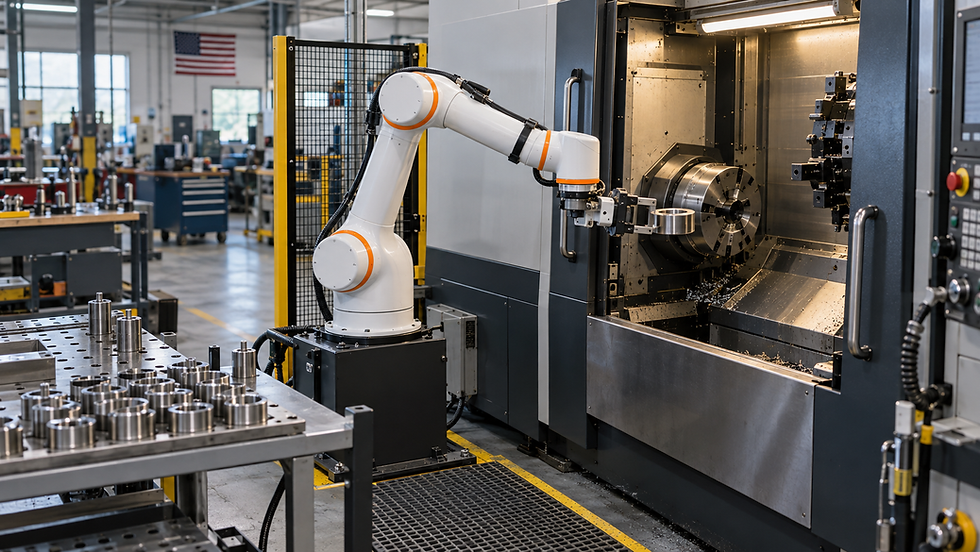
Those numbers do not mean that every company should buy a robot. They mean that automation capability is becoming part of ordinary competitive infrastructure. A small or midsize manufacturer no longer needs automotive-scale volume or an internal robotics department to automate a useful task. Compact six-axis collaborative robot arms, application kits, machine-vision systems, flexible grippers and browser-based programming have lowered the technical threshold. Yet the commercial threshold remains the same: the project must solve a real operating problem, work safely, survive production variability and return more value than it consumes.
This guide explains how to move from “How can I automate my business?” to a working automation cell with a defensible return on investment. It covers process selection, robotic-arm feasibility, total installed cost, safety, integration, workforce preparation, testing and scale. It also examines documented projects in metalworking, CNC machining, food production, plastics and process manufacturing. The goal is not to make automation sound effortless. It is to make the decision understandable enough that a business owner can ask better questions, reject weak proposals and recognize a strong first project.
Automation Begins With a Constraint, Not a Robot
The most useful definition of automation is the transfer of repeatable decisions or physical actions from continuous human execution to a controlled system. That system may be software connecting an ERP platform to a quality database. It may be a conveyor and sensor. It may be a fixed industrial robot behind guarding, or a collaborative robot arm that operates in a shared production area under a validated safety concept. Most modern projects combine several of these elements.
This broad definition prevents a common mistake: forcing a six-axis robot into a problem that a fixture, gravity chute, barcode scanner or software connection could solve more cheaply. NIST’s guidance for small and midsize manufacturers explicitly advises companies to calculate ROI holistically, because the analysis may show that a manual improvement or non-robotic form of automation is faster, safer and less expensive than a cobot. That is not an argument against robotic automation. It is an argument for earning the right to use it.
Start with the operating constraint. If customer orders are late, find the exact operation controlling throughput. If overtime is rising, determine whether the cause is labor availability, changeover, rework, unplanned downtime or poor scheduling. If an operator is stationed at a CNC machine, measure how much of the shift involves value-adding judgment and how much consists of opening a door, removing a part, cleaning a fixture, loading a blank and pressing cycle start. If the business wants robotic palletizing, calculate the actual case flow, pallet patterns, lift height, product weight and frequency of product changes.

The distinction between symptoms and constraints is crucial. “We cannot hire enough people” is a business symptom. The automatable constraint might be a repetitive machine-tending station that consumes 35 operator-hours a week, a palletizing task that causes fatigue late in a shift, or a welding process for six stable, high-volume assemblies. When the task is defined at this level, an automation supplier can test it. When it remains an abstract ambition to “use AI and robots,” proposals become difficult to compare and outcomes become difficult to verify.
The strongest first project usually has four characteristics. The task repeats often enough to matter; inputs and outputs are reasonably predictable; success can be measured with a small set of operational metrics; and failure will not stop the entire plant. NIST’s collaborative-robot integration study advises smaller manufacturers to begin with a simpler workcell because selecting the wrong process is a significant nontechnical risk. It also notes that cells with lower process and product variability are generally more favorable than cells in which dimensions, finishes, poses or procedures change frequently.
Stage One: Build an Automation Baseline
Before inviting vendors to the facility, document how the current process actually performs. A useful baseline should cover at least two representative weeks and, where relevant, more than one shift. Seasonal businesses may need a longer sample. The purpose is to replace assumptions with evidence and to preserve a fair before-and-after comparison.
For a production task, record demand, scheduled hours, actual run time, total units, good units, scrap, rework, cycle-time distribution, changeover duration, planned stops, unplanned stops, operator attendance, overtime and work-in-process. Do not rely only on an average cycle time. A process averaging 42 seconds may alternate between 30-second cycles and frequent two-minute interruptions. A robot designed around the average may miss the true constraint.
Observation is especially important. Create a simple time study that separates machine time from operator touch time. During machine tending, for example, the CNC may cut for four minutes while a person needs only 35 seconds to unload and reload it. Automating those 35 seconds can release the operator to supervise several machines, but only if blanks arrive consistently, finished parts have somewhere to go, chips do not block the fixture and tool life is controlled. The value comes from the system around the robot, not from the arm moving in isolation.
Quality must also be defined numerically. Record first-pass yield, defect categories, inspection time, customer returns and the cost of poor quality. A robotic welding system may produce more parts per hour, but its real advantage could be consistency in torch angle, travel speed and path repetition. A machine-vision inspection cell may not remove much labor, yet it can create traceable inspection data and stop defects before downstream assembly adds more cost.
Ergonomic exposure deserves the same treatment. Document load weight, lifts per shift, reach distance, wrist orientation, push-pull force, vibration, heat, fumes and monotonous repetition. OSHA states that fitting work to people can reduce muscle fatigue and the number and severity of work-related musculoskeletal disorders. The wider context is significant: U.S. private-industry employers reported 2.5 million nonfatal workplace injuries and illnesses in 2024. Cases involving days away from work during 2023–2024 had a median of eight days away, while job-transfer or restriction cases had a median of 15 days. Automation does not automatically eliminate risk, but an ergonomic burden that can be engineered out of a process belongs in the financial and safety case.
The baseline should end with a concise problem statement. A good version sounds like this: “Station 4 requires 1.6 full-time-equivalent operator positions across two shifts, averages 210 good parts per hour, loses 6.5 hours per week to breaks and staffing gaps, and creates 14 percent of the department’s ergonomic reports. The project target is 270 good parts per hour, less than 2 percent unplanned cell downtime, and removal of continuous manual handling, without reducing first-pass yield.” This statement gives management, workers, integrators and equipment suppliers the same finish line.
Stage Two: Rank Processes Before Choosing One
Most companies have more potential automation projects than they can execute. The answer is not to choose the task that looks most impressive in a demonstration. It is to rank opportunities using consistent criteria.
An automation opportunity matrix can score each candidate from one to five across business value, technical readiness, safety benefit, workforce impact and implementation risk. The most attractive task is not necessarily the one with the highest labor cost. A slightly lower saving paired with stable parts, easy access, short integration time and a natural manual fallback may create much more reliable value.
Decision dimension | What a strong first project looks like | Warning sign |
Repetition | Stable sequence repeated many times per shift | Every unit requires a new method |
Part presentation | Parts arrive in known positions or can be fixtured | Tangled, reflective or randomly oriented parts with no vision plan |
Business impact | Removes a verified bottleneck or protects important capacity | Automates an operation with excess capacity |
Cycle time | Robot and peripherals can meet takt with margin | Feasibility depends on maximum advertised speed |
Quality | Pass/fail condition can be measured | Quality depends on undocumented operator intuition |
Safety | Hazard can be controlled and validated | Sharp, hot or heavy tooling assumed safe merely because the arm is a cobot |
Changeover | Product families share fixtures and recipes | Constant one-off work with long re-teaching |
Recovery | Operators can understand and recover common faults | Every interruption requires the original integrator |
Continuity | A manual or bypass mode exists during ramp-up | Installation removes the only production route |
The matrix should be completed by a cross-functional group. Operations knows where flow breaks down. Operators know which “simple” tasks contain hidden judgment. Maintenance knows which sensors become unreliable and which machines lack usable interfaces. Quality understands process limits. Safety personnel see hazards that throughput calculations overlook. Finance can challenge optimistic savings. An integrator can then validate technical assumptions rather than discovering them after a purchase order.
This approach also changes workforce behavior. Employees are less likely to resist automation when they participate in selecting and designing the task. The conversation becomes specific: which motions should disappear, which decisions should remain human, what new skills are needed and how the employee’s role changes. Automation is then understood as process engineering rather than an unexplained threat.
Stage Three: Decide What Level of Automation the Process Needs
Automation exists on a continuum. At one end, a redesigned workstation, poka-yoke fixture or automatic screwdriver improves manual work. Next come semi-automatic systems in which a person loads a fixture and a machine completes the cycle. Flexible robotic cells use programmable motion and interchangeable tools. At the high end, linked systems coordinate robots, conveyors, vision, inspection, production scheduling and plant data.
A traditional industrial robot is often the right choice for very high speed, large payloads, long reach or highly repetitive production in a segregated cell. A collaborative robot is often attractive when floor space is limited, product mix changes, the system must be redeployed, programming resources are limited, or people and automation need controlled access to the same general work area. The IFR notes that cobots are generally easier to program and relocate, but they trade away some speed and payload compared with conventional industrial robots.
The word “collaborative” must not be treated as a guarantee of a fenceless installation. NIST makes the more precise point that there are no inherently collaborative applications simply because a particular robot model is called a cobot; the complete robot system and its task must be assessed. A power-and-force-limited arm fitted with a sharp drill, hot welding torch, fast spindle, heavy gripper or unstable workpiece can create a hazardous application. Depending on the risk assessment, the final cell may require monitored stops, speed and separation monitoring, scanners, light curtains, guarding or a fully enclosed space.
The right question is therefore not “industrial robot or cobot?” in the abstract. It is “What system architecture delivers the required throughput and quality while reducing risk to an acceptable level?” A collaborative robotic arm can still be valuable inside a guarded cell because it may be easier to program, smaller, more flexible and quicker to repurpose. Conversely, an apparently simple pick-and-place task may be better served by a high-speed delta robot if volume and takt dominate every other requirement.
Stage Four: Prove Technical Feasibility as a Complete Robotic System
A robotic arm is only one component of an automation cell. The full system may include a base, pedestal or mobile cart; end-of-arm tooling; fixtures; feeders; conveyors; machine vision; presence and position sensors; safety devices; a PLC; communication interfaces; guarding; cable management; extraction; inspection equipment and software. The feasibility study must consider all of them as one process.
Payload is the first screening variable, but it is frequently misunderstood. The robot must carry the workpiece plus the gripper, tool changer, hoses, cables and any force-torque or vision hardware mounted at the wrist. It must do so at the required center of gravity and throughout the planned motion. A 10-kilogram part does not automatically belong on a 10-kilogram robot. If the gripper and adapter weigh 3 kilograms, the nominal requirement is already at least 13 kilograms before dynamic margin is considered.
Reach is also more than the straight-line distance from the robot base to the farthest point. Engineers should model approach angles, joint limits, singularities, interference with the machine door, fixture height, tool length and space needed to reorient the part. A long-reach cobot can access a deep CNC machine or a wide pallet, but the payload curve at extension and the stiffness of the base still matter. A digital layout or simulation should be followed by a physical reach test whenever uncertainty remains.
Cycle-time analysis should divide the sequence into observable elements: detect part, approach, grip, verify grip, retract, travel, orient, place, release, confirm placement and return. Include door opening, clamp actuation, machine handshake, inspection, label printing and recovery from a missed pick. Then apply an allowance for ordinary variation. A proposal that meets takt only under a perfect demonstration is not production-ready.
Part presentation is often the difference between a modest project and an expensive one. Neatly fixtured components may require a simple parallel gripper and two position sensors. Random parts in a bin may require 3D vision, lighting, collision-aware path planning and a strategy for parts the system cannot identify. Flexible automation does not eliminate the need to control inputs. It shifts the question from “Can a person adapt?” to “How will the system detect and respond to variation?”
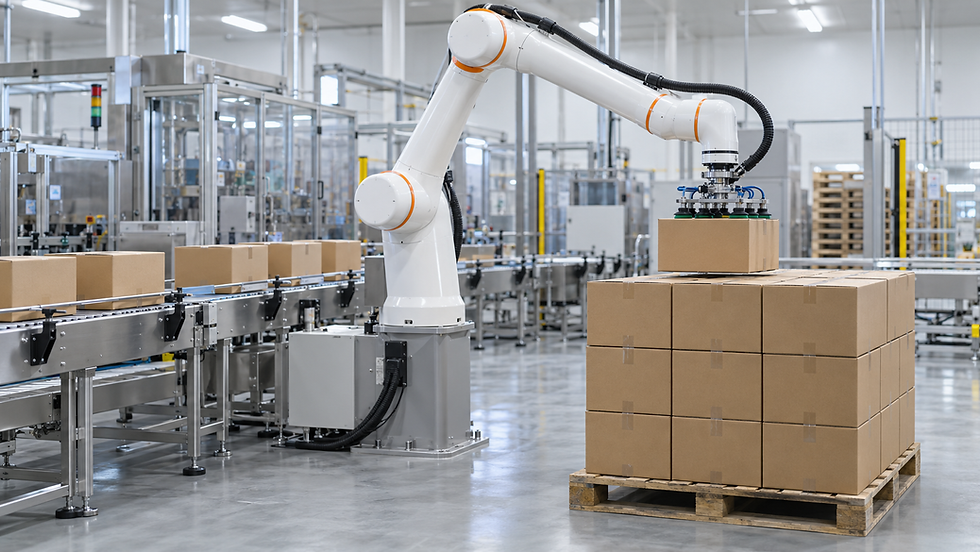
End-of-arm tooling deserves disproportionate attention because it touches the product and often creates the application’s main hazard. Vacuum gripping can be fast and gentle, but porous cartons, oily surfaces, leaks and pump capacity affect reliability. Mechanical grippers offer positive retention but must tolerate dimensional variation. Magnetic tools can handle ferrous parts but require a plan for residual magnetism and power loss. Welding packages need torch mounting, wire management, fume control, grounding, seam access and a validated process window. Sanding and polishing need force control, consumable monitoring and dust extraction.
Interfaces are equally important. A robotic machine-tending cell needs a safe way to know that the machine is ready, command the door and chuck or vise, initiate the cycle and receive completion and alarm states. Hardwired I/O may be sufficient; more sophisticated systems may use industrial Ethernet or a PLC. The system should fail to a known safe state when communication is lost. If operators must repeatedly override interlocks to keep production running, the design has failed even if the robot motion itself is reliable.
Finally, design for abnormal conditions. Ask what happens when two parts stick together, a box is missing, a vacuum cup wears out, a weld wire jams, the CNC tool breaks, the pallet is misplaced, power returns after an outage or a worker enters the area. Production automation lives in these exceptions. The best cells make faults visible, stop safely, preserve useful diagnostic information and allow trained employees to recover without rewriting the program.
Stage Five: Treat Safety as an Engineering Deliverable
Robot safety is not a sticker, a software setting or a sentence in a quotation. It is a documented process covering the arm, tooling, material, surrounding machines, people, foreseeable misuse and every phase of the equipment life cycle. OSHA notes that many robot accidents occur during non-routine activities such as programming, maintenance, testing, setup and adjustment. Those are exactly the moments when people are closest to equipment and normal production safeguards may be altered.
In the United States, ANSI/A3 R15.06-2025 is the current national standard for industrial robots and robot systems. Parts 1 and 2 address industrial robots and robot applications/cells, and the revision adopts ISO 10218 Parts 1 and 2. The 2025 update clarified functional safety, integrated collaborative-application guidance, added material relating to end effectors and manual loading, updated classifications and introduced cybersecurity guidance as part of safety planning. ISO/TS 15066 remains a relevant source for collaborative industrial robot systems and work environments, supplementing ISO 10218.
A professional risk assessment examines hazards by task and operating mode. Normal automatic operation is only one mode. Loading, teaching, cleaning, tool changing, jam clearing, troubleshooting, restart and maintenance must be considered separately. The team evaluates severity, exposure and probability, applies risk-reduction measures, and verifies that those measures work. The final record should show assumptions, safety functions, validation results, residual risks and required training.
The hierarchy of controls remains useful. First eliminate a hazard where possible. Then reduce it through design, guarding and safety-rated controls. Administrative procedures and personal protective equipment support the design but should not carry a burden that can be engineered away. If a sharp product can be deburred before a shared task, that may be better than relying on low robot speed. If a welding arc and fumes make close collaboration unnecessary and undesirable, guarding and extraction may be the sensible architecture even with a collaborative robot arm.
Cybersecurity now belongs in the same conversation because networked automation can affect physical behavior. Access control, software updates, backups, remote-support permissions, network segmentation and change management should be specified before commissioning. A convenient remote connection that bypasses normal plant controls can become both a business-continuity risk and a safety issue.
Acceptance should include safety validation by competent personnel, not merely a demonstration that an emergency stop halts movement. Safety scanners, interlocks, reduced-speed zones, stopping distances, payload settings and tool configurations must match the final cell. Any later change to the part, end effector, layout, speed or operating method should trigger a documented review; a previously validated cell does not remain automatically valid after its application changes.
Stage Six: Build a Financial Model That Includes the Entire System
The headline price of a robotic arm is not the project price. A credible budget includes the arm and controller, end-of-arm tooling, base or mobile platform, fixtures, part presentation, safety equipment, vision, PLC and electrical work, integration engineering, programming, freight, installation, training, validation, internal labor, production interruption, spares and contingency. Ongoing costs may include preventive maintenance, consumables, software, calibration, support, energy and future revalidation.
NIST’s study captures the range of real-world integration clearly. It reports a common experience of ROI in roughly 14 months for suitable collaborative-robot projects. It also advises small and midsize manufacturers to budget around three times the cobot-system price for integration in some situations, while noting that some MEP experts have seen development, fixturing, end-effectors and deployment cost only one-half to one times the cobot price. The range is not a contradiction. It reflects the enormous difference between a simple pre-engineered tending kit and a custom cell with vision, special tooling and machine modification.
The basic annual benefit should combine labor capacity released, overtime avoided, incremental contribution margin, scrap and rework reduction, avoided downtime, reduced outsourcing, quality savings and measurable safety-related savings. Avoid claiming the full wage of every employee who touches the process. If a worker is redeployed rather than removed, the value is the productive capacity created, overtime avoided or additional output enabled. That can be more valuable than headcount reduction, but it must be connected to real demand.
For a simple payback calculation:
Annual net benefit = annual gross benefit − annual operating and support cost
Payback period in months = total installed investment ÷ annual net benefit × 12
For a fuller analysis over several years:
ROI = (cumulative net benefit − total investment) ÷ total investment × 100
Net present value should be used when the time horizon is long or the company compares automation with other capital projects. The model should also include an expected-value adjustment for technical and utilization risk. A cell capable of saving $120,000 a year at full production may be worth only $84,000 in the base case if realistic uptime and demand produce 70 percent utilization.
Consider an illustrative machine-tending project. The robot arm, controller and teach interface cost $11,699. Tooling, fixture and pedestal cost $14,000; safety devices and validation cost $9,000; machine interface and electrical work cost $7,500; integration, programming and training cost $18,000; freight, spares and contingency add $7,800. Total installed investment is therefore $68,999, almost six times the arm’s price. If the cell releases 1,800 productive labor hours valued at $31 per hour, avoids $18,000 in overtime, adds $22,000 in contribution margin through unattended production and saves $6,000 in scrap, gross annual benefit is $101,800. After $8,500 in annual support, maintenance and consumables, annual net benefit is $93,300 and simple payback is about 8.9 months.
Now stress-test the same case. At 70 percent of the expected capacity benefit and with annual operating cost of $12,000, net benefit falls to roughly $59,260 and payback extends to about 14 months. This is still attractive, but it is a much more useful promise than a best-case calculation. A decision-quality model should show downside, base and upside scenarios, with the variables management can later compare against actual performance.
Opportunity cost matters as well. A business that cannot accept orders because welding capacity is full should value recovered capacity using contribution margin, not only labor savings. A machine shop that enables 14 additional unattended hours can defer another machine purchase or shorten lead time. A food plant that removes three people from palletizing may redeploy them to harder-to-automate work and protect production during a hiring shortage. In 2025, U.S. manufacturing still averaged about 407,000 job openings across the year, including 267,000 in durable-goods manufacturing. Automation investments often protect output in a labor-constrained environment even when no position is eliminated.
Stage Seven: Select the Robot, Tooling and Integration Partner
Robot selection should follow the application specification. Begin with payload including tooling, required reach, repeatability, speed, footprint, mounting orientation, protection class, environmental limits and communication. Then consider programming workflow, available application packages, spare parts, documentation, local support, warranty, safety functions and the practical skill level required to operate and recover the cell.
FAIRINO’s six-axis collaborative robot range illustrates how application requirements map to different arm classes. The compact FAIRINO FR3 has a 3 kg nominal payload, 622 mm reach and ±0.02 mm published repeatability, which suits light pick-and-place, inspection and small assembly. The FR5 raises nominal payload to 5 kg and reach to 922 mm for applications including light machine tending, welding, packaging and inspection. The FR10 provides a 10 kg class option for more demanding material handling and machine tending. The FR16 combines a 16 kg nominal payload with 1,034 mm reach and ±0.03 mm published repeatability, while the long-reach FR20 offers a 20 kg nominal payload and 1,854 mm reach for palletizing, large-machine access and heavy handling. The FR30 provides 30 kg nominal payload and 1,403 mm reach for heavy pick-and-place, packaging and palletizing.
FAIRINO cobot | Nominal payload | Published reach | Public U.S. arm price | Typical starting applications |
FR3 | 3 kg | 622 mm | $6,799 | Inspection, light assembly, compact pick-and-place |
FR5 | 5 kg | 922 mm | $7,999 | Light machine tending, welding, dispensing, packaging |
FR10 | 10 kg | 1,400 mm | $10,199 | Machine tending, welding, material handling |
FR16 | 16 kg | 1,034 mm | $11,699 | Heavier tending, screwdriving, deburring, packaging |
FR20 | 20 kg | 1,854 mm | $15,499 | Long-reach tending, palletizing, heavy handling |
FR30 | 30 kg | 1,403 mm | $18,199 | Heavy palletizing, large parts, packaging and assembly |
Prices above are public FAIRINO USA arm listings observed September 9, 2026 and are not estimates of a turnkey cell. Final specifications, availability and project pricing should be confirmed for the exact configuration.
The least expensive arm that can theoretically touch the part is not always the best value. Payload margin can permit a stronger gripper. Additional reach can simplify layout. Better environmental protection can avoid an enclosure. A smaller arm can reduce footprint and collision risk. Conversely, oversizing can add mass and cost without improving the process. Selection should be documented against the same requirement sheet used to evaluate every proposal.
The integrator is as important as the robot brand. A strong integrator asks for parts, cycle data, machine documentation and safety requirements before promising performance. The proposal defines scope boundaries, expected cycle time, assumptions, exclusions, deliverables, acceptance criteria, training, documentation, intellectual-property access, support response and change-control rates. It identifies who supplies fixtures, utilities, network access, risk assessment, installation labor and production support.
Reference checks should be application-specific. Experience building palletizers does not automatically qualify a supplier for precision force-controlled assembly. Ask to see a cell performing a similar task, with similar part variability and production conditions. Speak with the customer about recovery after faults, not only initial commissioning. The commercial objective is not a beautiful factory acceptance test; it is a system that the plant can own six months later.
For U.S. businesses evaluating FAIRINO robotic arms, local application support and integration planning should be discussed at the start, not after the equipment arrives. The correct conversation covers the complete workcell, realistic production goals and safety requirements. A qualified integrator such as Devonics can help translate the operation into tooling, controls, fixtures, guarding and validation rather than treating the robot arm as a standalone purchase.
Stage Eight: Run a Pilot With Written Acceptance Criteria
A pilot is not a trade-show demonstration. Its purpose is to retire the largest uncertainties before the business commits to full production. A meaningful pilot uses representative parts, including the range of sizes, finishes and tolerances that the cell will encounter. If oil, dust, glare, flexible packaging or imperfect cartons exist in production, the test should include them. Ten ideal pieces prepared by the supplier prove very little.
Before testing begins, write the acceptance criteria. Required throughput should be stated as good units per hour over a defined run, not the fastest observed robot cycle. Quality should use the same gauge and specification as normal production. Reliability can be expressed as the percentage of cycles completed without intervention or as maximum unplanned stops during an extended run. Changeover should include the time and skill needed to switch recipes, grippers or fixtures. Safety acceptance should refer to the completed risk assessment and validation plan.
The factory acceptance test, normally conducted before shipment or final installation, should verify sequence, interfaces, tooling, alarms, recipes, documentation and agreed performance to the extent possible at the builder’s facility. The site acceptance test repeats critical tests after installation with real utilities, upstream and downstream processes, operators and production conditions. Final payment milestones should be connected to objective acceptance, while recognizing that optimization and operator learning may continue during ramp-up.
An effective pilot also proves recovery. Deliberately introduce a missing part, misaligned blank, failed grip, full output tray, opened guard, network interruption and emergency stop. Observe whether the system enters a safe, understandable state. Ask a trained operator—not the original programmer—to identify the cause and recover. A cell that performs 500 perfect cycles but takes 45 minutes to recover from one ordinary exception may not achieve its financial model.
Data collection should begin on the first production day. At minimum, track scheduled time, run time, good output, rejected output, cycle time, faults by cause, intervention time, changeover time and manual fallback hours. Overall equipment effectiveness can be useful, but a single composite number should not hide the cause of loss. Availability, performance and quality should remain visible separately. During ramp-up, a short daily review should identify the largest recurring loss and assign one owner to correct it.
Stage Nine: Prepare the Workforce to Own the System
Automation changes work even when it does not reduce employment. Someone must load materials, select recipes, inspect quality, replace consumables, respond to faults, maintain tooling and decide when a process change requires engineering review. If these responsibilities are not designed, they emerge informally, often concentrating knowledge in one enthusiastic employee or the outside integrator.
Training should be role-based. Operators need safe start-up and shutdown, recipe selection, normal replenishment, alarm interpretation, quality checks and approved recovery procedures. Maintenance personnel need deeper diagnostics, backup and restore, mechanical inspection, calibration and lockout/tagout procedures. Process or manufacturing engineers need program structure, parameter management, change control and the boundary between ordinary adjustment and a change requiring new validation. Supervisors need to understand the metrics well enough to distinguish a robot problem from upstream starvation, poor scheduling or worn tooling.
The documented Poly-Tech Plastic Molding project shows why training belongs in the investment rather than as an optional extra. The Arkansas manufacturer paired its collaborative robot with employee training in programming, quality checks and routine maintenance. NIST reports $196,450 in cost savings, $225,000 in new investment and 90 jobs created or retained in connection with the broader project. The lesson is not that every cobot will produce those numbers. It is that technology and workforce capability were treated as one operating system.
Management should communicate the purpose before installation. If the goal is to remove an ergonomic burden, extend machine utilization or absorb growth without chronic overtime, say so. Explain which roles will change, what training will be offered and how performance will be evaluated during ramp-up. Employees who expect a robot to work perfectly on day one may interpret ordinary commissioning problems as proof of failure. Employees who understand the learning period are more likely to report faults and improve the process.
Documentation must be usable on the floor. A hundred-page technical manual is not a substitute for illustrated start-up, changeover and recovery procedures. Backups should be versioned and stored securely. Tooling, fixtures, recipes and safety configurations should have identifiable revisions. When an operator discovers a better method, the change should enter a controlled process rather than becoming unrecorded tribal knowledge.
Stage Ten: Stabilize the First Cell Before Scaling
The first project creates more than financial return. It creates internal competence. The company learns how to specify a task, collect cycle data, evaluate grippers, work with an integrator, validate safety, train employees and manage production ramp-up. That capability reduces risk on the second and third applications.
Scaling should begin only after the first cell has stable evidence. Compare actual results with the baseline and the approved financial model. If labor capacity was expected to be redeployed, confirm where it went and what value it created. If unattended operation was promised, measure how many productive hours actually occurred. If scrap fell, verify that the improvement came from the automation rather than a simultaneous material change. If payback is behind plan, identify whether the cause is utilization, reliability, demand, cycle time or an omitted operating cost.
Standardization then turns one cell into a repeatable platform. Common robot models, safety components, electrical drawings, HMI conventions, alarm structures, spare parts and programming patterns can reduce training and support burden. Standardization should not force every process into the same design, but it should prevent every project from becoming a custom island.
The next opportunity matrix can now use actual company data rather than industry assumptions. The team knows its integration cost, training time, ramp curve and fault profile. A gripper or machine-interface design may be reusable. Operators from the first cell can mentor the next group. The business is no longer “trying a robot”; it is developing an automation system.

What Real Automation Projects Teach Across Industries
Case studies are useful only when the application and boundary conditions are understood. A six-month payback in one plant is not a universal promise. Still, documented outcomes reveal patterns that apply across sectors: good projects target an operating constraint, include process engineering, and treat people as a source of capacity rather than a cost line to erase.
Automotive Components: AMG Industries and Repetitive Machine Work
AMG Industries identified a repetitive production problem involving an exhaust component. Through an Ohio Manufacturing Extension Partnership robot-loaner program, MEP engineers observed the operation, installed and programmed a collaborative robot, and helped the company test the application before purchasing equipment. Production rose from about 200 to 276 parts per hour, a 38 percent increase. Workers were redeployed to other needed areas. The company had forecast an 11.5-month payback, but NIST reports that actual payback fell to 6.5 months; it later purchased a UR10e for the role.
The transferable lesson is not the robot brand. It is the sequence. AMG began with a specific high-repetition part, used a structured trial to reduce technical and financial risk, measured throughput against the manual baseline and retained flexibility to deploy people elsewhere. A business considering a collaborative robot for repetitive loading, forming or handling should copy this experimental discipline.
The case also illustrates why good-unit throughput is superior to a theoretical cycle-time claim. The improvement was expressed in actual hourly production. That number can be translated into capacity, labor allocation and payback. It also provides a target against which drift can be detected after the launch team leaves.
Food Production: HoneyBaked Ham and Robotic Palletizing
At a HoneyBaked Ham facility in Ohio, labor shortages affected an end-of-line palletizing operation. A manufacturing assessment identified robotic palletizing as the appropriate response. The system was designed for one line operating two shifts and replaced a task previously performed by three employees, who could then be used in work that was more difficult to automate. NIST reports an eight-month return on investment, $220,000 in new investment and $200,000 in cost savings.
Palletizing is often a strong automation candidate because cases arrive in a controlled flow, pallet patterns are definable and the lifting burden accumulates throughout a shift. Yet food and beverage projects add constraints: sanitation, washdown requirements, packaging integrity, allergen or product segregation, temperature, condensation and line-clearance procedures. A robotic palletizer must also handle pattern changes, pallet supply, slip sheets, full-pallet discharge and the consequences of upstream variation.
For a smaller food producer, the appropriate solution may be a collaborative palletizing cell that can switch recipes and fit beside an existing conveyor. A higher-speed operation may justify a guarded industrial robot. The method remains the same: measure the real case rate and peak demand, include all case weights and dimensions, design replenishment and discharge, validate the entire area and calculate value using redeployed labor plus protected output.
Metal Fabrication: Brownell and Robotic Welding
Brownell, a Massachusetts manufacturer, introduced a welding robot to produce popular products more efficiently. The system initially covered three SKUs and later six, allowing human welders to concentrate on new and more complex work. NIST reports a 25 percent productivity improvement and approximately $125,000 in sellable inventory, while the automation helped the company reduce backorders and keep up with demand.
Robotic welding is compelling when a shop has repeatable weldments, stable joints, sufficient volume and a shortage of skilled capacity. It is less compelling when every assembly is unique, fit-up is inconsistent or the robot would spend most of its time waiting for fixtures to be prepared. The welding process should be engineered before motion is programmed: joint access, tolerances, tack strategy, distortion, wire, gas, power source, torch angle, travel speed, cleaning and inspection all matter.
A collaborative welding robot can make programming and redeployment accessible to a smaller shop, but collaborative motion does not make the arc, hot metal, spatter or fumes harmless. The risk assessment may require guarding, extraction and controlled access. The best economic model usually preserves skilled welders for complex work, setup, process development and quality while the robotic cell produces stable families of parts.
Aerospace CNC Machining: Rimeco and the Importance of the Complete Cell
Rimeco Products used a collaborative robot with a Haas VF-2 mill for a high-volume aerospace part. The implementation included a machine safety system, custom fixtures, end-of-arm tooling, robot programming, CNC communication and inspection algorithms that adjusted tooling offsets. Human attention was reduced mainly to material replenishment and periodic tool changes. NIST reports $55,000 in new investment, $10,000 in cost savings, two additional robots purchased later for turning centers, and staff redirected to other work.
This case exposes the misleading simplicity of the phrase “load and unload a CNC.” Reliable machine tending depends on blank presentation, gripping, door control, workholding, chip management, tool life, in-process measurement, part output and fault recovery. Rimeco’s inspection algorithms and offset adjustments were not decorative features; they helped make continued production feasible with limited oversight.
For any machine shop searching for a CNC machine-tending robot, the first engineering question should be whether the machining process itself is stable. Automating an unstable process can multiply scrap during unattended hours. Tool monitoring, probing and quality strategy may produce more value than shaving a second from the robot path.
Precision Manufacturing: Coventry Industries and Lights-Out Capacity
Coventry Industries used a technology-opportunity assessment to identify collaborative machine tending for optic plates. Three CNC operators learned to program the cobot and set it up for different parts. NIST reports that the company achieved a first lights-out run adding 14 production hours to the day and moved from project to production within days.
Unattended production changes the business case because it can create capacity without adding another staffed shift. But “lights out” should be earned gradually. The process must detect missing or incorrectly seated parts, machine faults, tool wear and output capacity. Fire protection, coolant behavior, chip evacuation and remote notifications may require review. The correct ramp often begins with attended cycles, advances to breaks and short unmanned periods, and reaches overnight operation only after fault data show stability.
Precision Components: Vanamatic and the Relationship Between Automation and Jobs
Vanamatic automated part loading on two machines. NIST reports labor savings in the range of 40 to 50 percent for the operation, along with quality, cycle-time and ergonomic improvements. The company used employees elsewhere, retained competitive pricing, expanded sales and instituted wage increases; the broader project recorded $1.52 million in new or retained sales and three jobs created or retained.
This is a more realistic description of automation’s workforce effect than a simple “robot replaces worker” equation. At a growing company, released labor can remove a production constraint, allowing people to perform work that requires judgment, troubleshooting, setup or customer responsiveness. The financial model must still be rigorous, but the unit of value is often capacity and resilience rather than eliminated payroll.
Plastics: Poly-Tech and Adaptable Production
Injection molding and extrusion contain promising robotic tasks: part removal, insert loading, gate trimming, inspection, labeling, packaging and machine tending. Poly-Tech Plastic Molding adopted a cobot in response to retention, efficiency and changing demand, then trained employees to program, maintain and perform quality checks on the system. NIST’s reported results—$196,450 in cost savings and 90 jobs created or retained—were tied to a wider competitiveness initiative, not presented as a guaranteed result for one arm.
Plastics automation must account for cycle synchronization, hot surfaces, mold access, static, part cooling, flexible parts and variation as tools wear. A cobot’s ease of reprogramming can help a high-mix molder, but quick software changeover is valuable only if grippers, fixtures and quality controls change just as efficiently.
Chemical Manufacturing: Enviro Tech and Automation Beyond Physical Motion
Enviro Tech Chemical Services faced disconnected PLC, ERP and quality-management systems. Integrating real-time production data through application interfaces reduced manual entry, improved traceability and supported quality control. No robotic arm was required to deliver this value.
This example belongs in a robotics guide because a physical cell should not become another data island. Batch identity, recipe, robot program, inspection result, operator action and production count may need to flow into the company’s existing systems. The best roadmap often combines digital automation with physical automation: stabilize master data, connect machines, then use robots where motion and handling remain the constraint.
Why Automation Projects Fail
The most common failure begins with an attractive machine and a vague problem. The business buys a cobot because it appears easy to program, then searches for a task. The selected process has low volume, unstable inputs or no real constraint. Even if the cell works, it does not create enough value to justify its cost.
Another failure is budgeting only for the robot arm. Tooling, fixturing, controls, safety and integration are treated as surprises, causing management to remove essential scope or abandon the project after the arm arrives. A related error is calculating payback from theoretical labor elimination without identifying where that labor will actually be removed, redeployed or converted into added production.
Underestimating variation is equally damaging. Sales literature shows a clean part in a fixed position, while the factory presents oily blanks, bent cartons, flash, inconsistent weld fit-up or several unlabeled product revisions. The robot repeats exactly what it has been instructed to do. It needs fixturing, sensing, vision or exception logic to deal with variability that a person previously handled without documenting it.
Safety shortcuts create both human and commercial risk. Assuming that low robot speed makes a sharp tool safe, disabling an interlock to improve output or copying a risk assessment from another cell can invalidate the entire project. Safety measures added late can also destroy the promised cycle time. Risk assessment belongs during concept development, when layout and process can still change economically.
Finally, companies sometimes outsource every piece of knowledge. The integrator can launch the system, but no one at the plant can modify a recipe, diagnose a sensor or restore a backup. Small faults create long delays and the robot earns a reputation for unreliability. The remedy is not to eliminate outside expertise; it is to define knowledge transfer, documentation and support as acceptance deliverables.
A Practical 90-Day Path From Question to Approved Project
During the first 30 days, the company should identify and observe candidate processes, capture baseline data and interview the people doing the work. Management can then rank opportunities and choose one primary cell plus one backup. At the end of this phase, the business should have a measurable problem statement, representative parts, current-state data and an initial view of the financial ceiling.
Days 31 through 60 should focus on feasibility. Develop a functional specification, model reach and payload, test gripping, confirm machine interfaces, outline the safety concept and estimate total installed cost. Invite qualified suppliers to respond to the same requirements. Where uncertainty is high, conduct a proof of concept using real parts. The business case should now show downside, base and upside scenarios rather than one payback number.
During days 61 through 90, select the architecture and partner, complete a preliminary risk assessment, agree on responsibilities and write the factory and site acceptance criteria. Define training roles, internal ownership, support response and the data that will be collected after launch. The result of the 90 days is not necessarily an installed robot. It is something more valuable: an approved, testable project whose technical, safety and financial assumptions are visible.
Installation timing depends on complexity and lead times. A pre-engineered collaborative robot cell may progress quickly; a custom welding, vision or multi-machine system will take longer. The business should protect production continuity throughout design, installation and ramp-up. A realistic schedule includes time for tooling revisions, operator learning and safety validation rather than treating mechanical delivery as completion.
How to Know Whether Your Business Is Ready
A business is ready for automation when it can define a process, measure its current performance, supply representative inputs, assign an internal owner and fund the complete solution. It does not need a robotics department. It does need management attention and access to the employees who understand the task.
Readiness also means accepting that automation will expose upstream problems. A robot may reveal inconsistent incoming material, undocumented product changes, unreliable preventive maintenance or production scheduling that starves the cell. This visibility is a benefit if the company is prepared to improve the process. It becomes frustration if every problem is blamed on the robot.
The first application should be important enough to matter but bounded enough to learn from. High-repetition machine tending, pick-and-place, palletizing, packaging, dispensing, inspection and stable welding families frequently meet that description. Complex bin picking, constantly changing one-off work and processes that depend on unrecorded craft knowledge may become good projects later, after the company has built automation competence.
The Central Decision
Starting automation is not primarily a decision about replacing labor. It is a decision about where the business needs consistent capacity, safer work, repeatable quality and better use of scarce human skill. The evidence from real plants shows that robotic systems can raise throughput, unlock unattended production, reduce strenuous handling and help companies grow. It also shows that the result depends on application selection, integration, training and measurement—not on the robot arm alone.
The practical path is disciplined. Measure the current process. Rank opportunities. Choose the lowest-complexity project that solves a meaningful constraint. Engineer the entire workcell. Complete and validate the risk assessment. Calculate return using total installed cost and realistic utilization. Test with representative parts. Train the people who will own the system. Stabilize the first cell, record the result and only then scale.
For a company ready to evaluate a cobot, the next productive step is not an immediate purchase. It is a structured application review using part weight, tooling, reach, takt time, layout, variability, quality requirements and safety conditions. That information makes it possible to determine whether a compact robotic arm, a long-reach cobot, a heavy-payload collaborative robot or a different form of automation offers the strongest business case. FAIRINO USA and an experienced U.S. integrator can then translate the chosen process into a complete, supportable automation cell.
Frequently Asked Questions
What is the best first process to automate in a small business?
The best first process is usually repetitive, measurable, reasonably stable and commercially important. Machine tending, pick-and-place, case packing, palletizing, dispensing and repeatable welding are frequent candidates. The right answer depends on the process constraint, not on which task is most visually impressive. A simple cell with clear inputs and a manual fallback generally teaches the organization more and reaches stable production faster than a highly variable flagship project.
How much does a collaborative robot system cost?
The arm is only one part of the cost. FAIRINO USA’s public arm listings currently range from $6,799 for the FR3 to $18,199 for the FR30, but a complete cell also needs tooling, fixtures, safety, integration and training. NIST reports that some smaller-manufacturer projects may add one-half to one times the cobot price for deployment-related components, while more complex integrations may justify budgeting around three times the cobot-system price. A custom turnkey cell can exceed those ranges. Only an application-specific scope can produce a credible price.
How fast should a robotic automation project pay for itself?
There is no universal threshold. NIST’s expert study reports common experience around 14 months for suitable cobot applications, while documented projects include 6.5-month and eight-month paybacks. Companies should set their own capital hurdle and compare downside, base and upside cases. Payback should include total installed investment and recurring cost, and benefits should be linked to real labor redeployment, overtime reduction, scrap, capacity or contribution margin.
Does a cobot eliminate the need for safety guarding?
No. A collaborative robot has safety functions intended to support collaborative applications, but the complete application determines the risk. Tooling, workpieces, speed, force, heat, sharp edges and adjacent machinery may require scanners, interlocks, guarding or separation. A task-specific risk assessment and validation are required. Calling an arm a cobot does not make the completed workcell safe by itself.
Can a cobot run a CNC machine overnight?
Yes, if the entire machining process is stable and designed for unattended operation. The system must handle part presentation, gripping, machine communication, workholding, chips, tool condition, output capacity, faults and safe restart. Documented NIST cases show businesses adding extended or lights-out production, including 14 additional production hours in one Coventry Industries application. The safest approach is to expand unattended duration gradually after reliability data supports it.
Will automation replace my employees?
Automation can reduce the direct labor required for a task, but business outcomes vary. In several NIST cases, companies redeployed employees, created or retained jobs, expanded sales or assigned skilled workers to more complex work. The management plan should state explicitly how affected roles change. Training operators to program, recover and maintain the cell can turn repetitive labor into higher-value capability.
How do I choose the right robotic arm payload?
Add the weight of the product, gripper, adapters, sensors, tool changer and wrist-mounted cables or hoses. Then account for center of gravity, acceleration, reach and a practical engineering margin. Do not select a 10 kg robot merely because the part weighs 10 kg. The detailed payload curve and intended motion must be reviewed by the supplier or integrator.
Do I need a systems integrator?
A very simple application kit may be deployed by a capable internal engineering team, but most first-time buyers benefit from an integrator. Integration includes tooling, fixtures, controls, machine interfaces, safety, programming, validation and training. NIST identifies vendor and integrator support as a major factor in implementation and ROI. The contract should still ensure that the plant receives documentation, backups and enough training to own normal operation.
What information should I prepare before requesting a quote?
Prepare representative parts and drawings, part and tool weights, required takt or good units per hour, shift pattern, production volume, product mix, changeover expectations, current cycle data, photos and layout dimensions, utilities, environmental conditions, machine interface documentation, quality criteria and known hazards. Include the current-state baseline and the commercial outcome the project must achieve. Suppliers can give much better proposals when they are solving a defined application rather than pricing an arm in isolation.
What metrics should I track after installation?
Track good output, scrap, cycle-time distribution, scheduled time, run time, unplanned stops, fault causes, intervention time, changeover, unattended hours, labor deployment, overtime and recurring operating cost. Compare these values with the original baseline and financial model. Keep availability, speed loss and quality loss visible even if the company also reports a composite metric such as overall equipment effectiveness.


