
The Manufacturing Labor Crisis Report 2026Why Cobots Deliver a Faster ROI Than Hiring Skilled Workers

A Data-Driven Analysis of Labor Shortages, Rising Costs, and the Future of Manufacturing Automation
Executive Summary
Manufacturing is entering a new era.
For decades, the formula for increasing production was simple: hire more workers, add more shifts, and expand operations. Today, that model is breaking down.
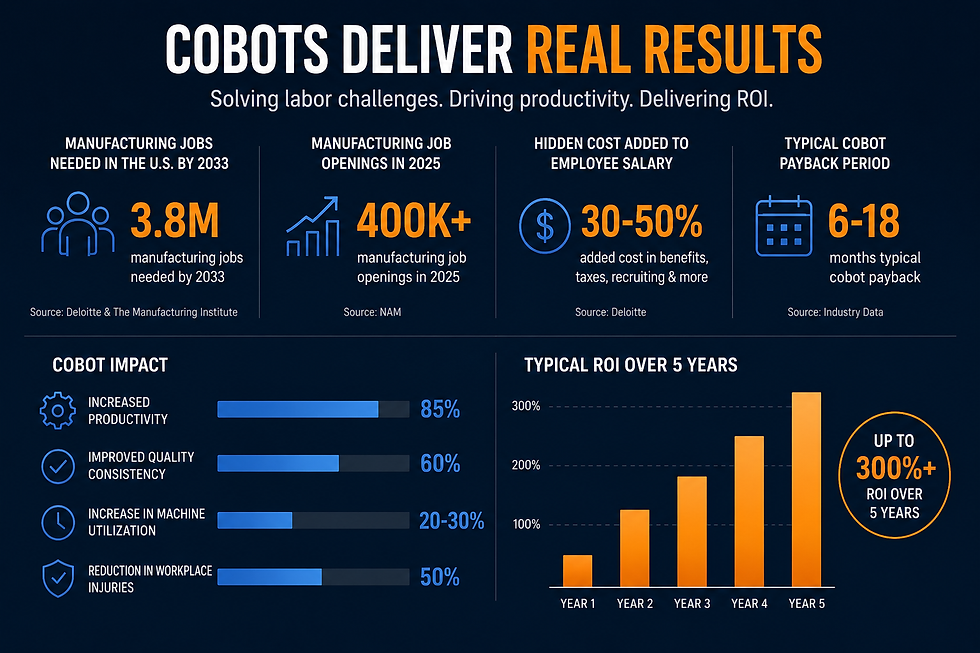
Manufacturers across the United States are facing a workforce crisis driven by labor shortages, retirements, wage inflation, turnover, and growing demand for skilled technical talent. According to research from Deloitte and The Manufacturing Institute, the U.S. manufacturing sector may need as many as 3.8 million new workers by 2033, yet nearly half of those positions could remain unfilled if workforce challenges continue.
The problem is no longer theoretical.
Manufacturers are already struggling to recruit welders, CNC operators, machine tenders, assemblers, maintenance technicians, and production specialists. Open positions remain vacant for months, production schedules are delayed, overtime expenses continue to rise, and valuable employees are increasingly difficult to retain.
At the same time, global competition is intensifying.
Manufacturers are under pressure to:
Produce faster
Reduce costs
Improve quality
Maintain delivery schedules
Increase output without increasing headcount
This combination of labor constraints and production pressure has accelerated one of the largest automation shifts in manufacturing history.
Collaborative robots—commonly known as cobots—have emerged as one of the most practical and cost-effective solutions available to manufacturers today.
Unlike traditional industrial robots that often require large investments, safety fencing, extensive programming, and months of deployment time, modern cobots can be integrated into existing workflows quickly and efficiently.
More importantly, they can generate measurable financial returns.
Many manufacturers are now discovering that the economics of automation have fundamentally changed.
The question is no longer:
“Can we afford automation?”
The question is:
“Can we afford not to automate?”
Chapter 1: The Manufacturing Workforce Crisis
Manufacturing Has a Labor Problem
The manufacturing sector continues to face significant workforce challenges.
According to The Manufacturing Institute and Deloitte, manufacturers could require up to 3.8 million additional workers between 2024 and 2033. More than 1.9 million of those positions could remain unfilled if labor shortages persist.
This labor gap is being driven by multiple factors:
Retirement of experienced workers
Insufficient numbers of younger skilled workers
Increased reshoring of manufacturing
Expansion of advanced manufacturing facilities
Growing technical requirements for modern production
Manufacturing companies are no longer competing only against other manufacturers for talent.
They are competing against:
Technology companies
Logistics companies
Construction firms
Energy companies
Aerospace contractors
The result is an increasingly competitive labor market.
The Skills Gap Is Expanding
The challenge is not simply finding workers.
The challenge is finding qualified workers.
According to manufacturing workforce studies, employers continue to report difficulties recruiting individuals with experience in:
Welding
CNC machining
Robotics
Automation
Industrial maintenance
Quality assurance
Production engineering
Many positions remain open for extended periods because qualified candidates simply are not available.
Manufacturing Job Openings Remain Elevated
Recent workforce reports show hundreds of thousands of manufacturing positions remaining open across the United States. Manufacturing job openings have remained in the 400,000–500,000 range throughout much of 2025 and early 2026.
This means manufacturers are often operating below their full production capacity.
For many companies, the issue is not demand.
The issue is labor availability.
Chapter 2: The Hidden Cost of Labor
Many manufacturers underestimate labor costs.
Most financial models focus on hourly wages.
However, wages represent only part of the true cost.
Example: Skilled Welder
Assume a skilled welder earns:
$32 per hour
Annual salary:
$66,560
Many business owners stop their calculations there.
That is a mistake.
Actual employment costs often include:
Cost Category | Annual Cost |
Base Wage | $66,560 |
Benefits | $12,000 |
Payroll Taxes | $5,100 |
Recruiting | $3,000 |
Training | $4,000 |
PPE & Equipment | $2,000 |
Productivity Ramp-Up | $6,500 |
Total Annual Cost
$99,160
A worker earning $66,560 may actually cost nearly $100,000 annually.
The Cost of Turnover
Turnover creates additional expenses.
When a skilled worker leaves, costs include:
Recruitment
Interviewing
Onboarding
Training
Overtime coverage
Reduced productivity
Even a short vacancy can disrupt production schedules.
For welding, CNC machining, and specialized manufacturing positions, replacement timelines may extend for months.
Chapter 3: The Revenue Impact of Labor Shortages
Most manufacturers calculate labor expenses.
Far fewer calculate lost revenue.
This is often where the biggest financial impact exists.
Example Scenario
A fabrication company generates:
$8 million annual revenue
Production requires:
12 welders
Only:
9 positions are filled
The result is not simply reduced payroll expense.
Instead:
Production slows
Orders are delayed
Lead times increase
New opportunities are declined
If labor shortages reduce output by only 15%, the business could potentially lose:
$1.2 million annually
The true cost of labor shortages is often much larger than labor itself.
Chapter 4: Why Traditional Industrial Robots Are Not Always Practical
Industrial robots have transformed manufacturing for decades.
However, traditional robotic systems frequently require:
Safety cages
Dedicated work cells
Specialized integration
Advanced programming
Significant capital investment
For large automotive manufacturers, these investments often make sense.
For small and mid-sized manufacturers, they frequently do not.
The Automation Gap
Many companies exist in an uncomfortable middle ground.
They are:
Too large to remain fully manual
Too small for traditional robotics
Historically, this automation gap prevented many manufacturers from adopting robotics.
Collaborative robots changed that equation.
Chapter 5: The Rise of Collaborative Robots
Collaborative robots were designed specifically to address the limitations of traditional robotic systems.
Instead of focusing exclusively on speed and scale, cobots emphasize:
Flexibility
Simplicity
Safety
Accessibility
Faster deployment
As a result, automation is now available to manufacturers that previously could not justify robotics investments.
Global Robot Adoption Is Accelerating
According to the International Federation of Robotics, global robot installations exceeded 542,000 units in 2024—more than double the number installed ten years earlier.
Meanwhile, collaborative robots continue to represent one of the fastest-growing segments of industrial automation.
Industry forecasts estimate strong long-term growth driven by:
Labor shortages
Reshoring initiatives
Rising labor costs
Increased demand for flexible automation solutions
Chapter 6: The Economics of Automation
The primary reason automation is accelerating is simple:
Return on investment.
Manufacturers are increasingly discovering that cobots generate measurable financial benefits.
ROI Formula
ROI=\frac{Total\ Savings-Total\ Investment}{Total\ Investment}\times100
Payback Formula
Payback\ Period=\frac{Automation\ Investment}{Annual\ Savings}
Chapter 7: Real-World Cobot ROI Scenarios
Scenario 1: Welding Automation
Current Labor Cost:
$100,000 annually
Estimated Cobot Cell Investment:
$65,000
Benefits:
Reduced labor dependency
Improved consistency
Lower rework
Extended production hours
Annual Savings:
$85,000
Estimated Payback:
9 Months
Scenario 2: CNC Machine Tending
Current Operator Cost:
$85,000 annually
Cobot System:
$55,000
Additional Machine Utilization:
20%
Annual Productivity Gain:
$40,000
Annual Labor Savings:
$45,000
Total Benefit:
$85,000
Estimated Payback:
Less than 8 months
Scenario 3: Palletizing
Manual palletizing frequently creates:
Injuries
Fatigue
Staffing shortages
Typical palletizing automation often produces:
Faster throughput
Reduced injuries
More consistent operations
Many manufacturers achieve payback within 12–18 months.
Chapter 8: High-ROI Manufacturing Applications
Not every process should be automated.
The best opportunities generally involve:
Repetitive motion
Consistent workflows
Labor shortages
High turnover
Ergonomic risks
Welding
One of the strongest automation opportunities.
Benefits:
Improved consistency
Reduced defects
Increased throughput
Machine Tending
Benefits:
Higher spindle utilization
Reduced downtime
Continuous operation
Pick and Place
Benefits:
Speed
Repeatability
Accuracy
Packaging
Benefits:
Labor reduction
Throughput improvement
Palletizing
Benefits:
Reduced injury risk
Increased output
Chapter 9: Why Manufacturers Are Choosing FAIRINO Cobots
The collaborative robotics market has expanded rapidly.
However, many manufacturers continue to face challenges with automation costs.
FAIRINO cobots are designed to make automation more accessible by combining:
Industrial-grade performance
Flexible deployment
User-friendly operation
Cost-effective ownership
This makes collaborative robotics practical for manufacturers that previously considered automation financially out of reach.
FAIRINO FR3
Ideal Applications:
Electronics
Precision assembly
Laboratory environments
FAIRINO FR5
Ideal Applications:
Small component handling
Product testing
Assembly support
FAIRINO FR10
Ideal Applications:
CNC machine tending
Packaging
Material handling
FAIRINO FR16
Ideal Applications:
Welding
Fabrication
Heavy-duty production tasks
FAIRINO FR20
Ideal Applications:
Material movement
Production support
FAIRINO FR30
Ideal Applications:
Palletizing
End-of-line automation
Chapter 10: AI, Smart Factories, and the Future of Manufacturing
The next wave of manufacturing will not simply be automated.
It will be intelligent.
Artificial intelligence is increasingly being integrated with robotics to enable:
Adaptive production
Predictive maintenance
Vision inspection
Process optimization
Production analytics
Manufacturers that adopt automation today position themselves to take advantage of future AI-driven manufacturing capabilities.
Chapter 11: The Cost of Waiting
Many manufacturers postpone automation for years.
The reasoning is often:
“We'll hire later.”
Unfortunately, labor market trends suggest the opposite.
The competition for skilled labor remains intense, and workforce shortages continue to affect manufacturers across North America.
Every year that automation is delayed can result in:
Lost production
Lost revenue
Higher labor costs
Reduced competitiveness
The longer manufacturers wait, the more expensive the transition often becomes.
Final ROI Example
Assume:
Automation Investment:
$70,000
Annual Labor Savings:
$60,000
Additional Productivity Gains:
$35,000
Total Annual Benefit:
$95,000
Five-Year Benefit:
$475,000
Net Gain:
$405,000
Five-Year ROI:
Nearly 580%
For many manufacturers, few investments can produce comparable returns.
Conclusion
Manufacturing is changing.
Labor shortages are no longer temporary.
Wage pressures continue to rise.
Competition is increasing.
Customer expectations continue to grow.
The manufacturers that succeed over the next decade will not necessarily be the ones with the largest workforce.
They will be the ones with the most productive workforce.
Collaborative robots offer manufacturers a practical path toward:
Higher output
Better quality
Reduced labor dependency
Greater operational resilience
Faster growth
The economics are becoming increasingly difficult to ignore.
For many companies, the question is no longer whether automation makes sense.
The question is how quickly it can be implemented.
Request a Free Automation Consultation
Every manufacturing operation is unique.
The highest-ROI automation opportunities depend on your processes, staffing challenges, production goals, and growth plans.
Our team can help identify where collaborative robotics can deliver the greatest impact within your facility.
Whether you are exploring welding automation, machine tending, palletizing, packaging, assembly, or material handling, we can help evaluate the financial opportunity and build a realistic automation roadmap.
Schedule Your Free Consultation
Contact our automation specialists today for a free, no-obligation assessment and discover how FAIRINO collaborative robots can help reduce labor shortages, increase productivity, and accelerate profitability.
Data - Deloitte, The Manufacturing Institute, U.S. Bureau of Labor Statistics ו־International Federation of Robotics.
Frequently Asked Questions About Cobots
What are cobots and how do they differ from traditional industrial robots?
Cobots, or collaborative robots, are designed to work safely alongside human operators. Unlike traditional industrial robots that often require safety cages and dedicated work cells, cobots are built for flexibility, easier deployment, and human-machine collaboration in manufacturing environments.
Why are cobots becoming more popular in manufacturing?
Cobots are becoming more popular because manufacturers face labor shortages, rising wages, and increasing production demands. Cobots help companies automate repetitive tasks while improving productivity, consistency, and operational efficiency.
How do cobots help solve manufacturing labor shortages?
Cobots help manufacturers maintain production levels when skilled workers are difficult to find. By automating repetitive and labor-intensive tasks, cobots allow existing employees to focus on higher-value work while reducing dependence on hard-to-fill positions.
Are cobots a good investment for small and medium-sized manufacturers?
Yes. Cobots are often more affordable and easier to implement than traditional robotic systems, making them a practical automation solution for small and medium-sized manufacturers seeking faster ROI and increased productivity.
What is the average ROI for cobots in manufacturing?
The return on investment for cobots varies by application, but many manufacturers achieve payback within 6 to 18 months. High-ROI applications such as welding, machine tending, and palletizing can often deliver significant savings and productivity gains.
How do cobots reduce manufacturing costs?
Cobots reduce costs by lowering labor dependency, minimizing production downtime, reducing scrap and rework, improving quality consistency, and increasing overall equipment utilization.
Can cobots work safely alongside human employees?
Yes. Cobots are specifically designed to operate safely near human workers using advanced sensors, force-limiting technologies, and built-in safety features that help reduce workplace risks.
What manufacturing tasks can cobots automate?
Cobots can automate a wide range of manufacturing tasks, including welding, machine tending, palletizing, packaging, assembly, pick-and-place operations, quality inspection, material handling, and testing processes.
Are cobots suitable for welding applications?
Yes. Welding is one of the most common and effective applications for cobots. Welding cobots help improve weld consistency, increase throughput, reduce rework, and address shortages of skilled welders.
How do cobots improve CNC machine tending operations?
Cobots can automatically load and unload CNC machines, reducing idle time and increasing machine utilization. This allows manufacturers to improve productivity while reducing operator workload.
Can cobots help manufacturers increase production capacity?
Yes. Cobots enable manufacturers to increase production without necessarily increasing headcount. They can operate consistently throughout shifts and help reduce bottlenecks that limit output.
How do cobots improve product quality?
Cobots perform repetitive tasks with high precision and consistency. This helps reduce human error, improve repeatability, decrease defects, and support higher quality standards.
What industries use cobots the most?
Cobots are widely used in automotive, metal fabrication, electronics, aerospace, medical device manufacturing, logistics, food processing, plastics manufacturing, and consumer goods production.
How long does it take to deploy cobots in a manufacturing facility?
Deployment times vary depending on the application, but many cobot systems can be installed and operational within days or weeks, significantly faster than traditional industrial robot installations.
Can cobots operate multiple shifts without breaks?
Yes. Cobots can operate continuously for multiple shifts with minimal downtime, helping manufacturers maximize equipment utilization and increase production output.
Are cobots replacing human workers?
In most cases, cobots are not replacing workers but helping manufacturers address labor shortages and improve productivity. Cobots often take over repetitive or physically demanding tasks while employees focus on more valuable responsibilities.
What are the advantages of cobots compared to hiring additional workers?
Cobots can provide consistent performance, operate for extended hours, reduce labor-related challenges, improve quality, and generate measurable ROI while helping manufacturers overcome workforce shortages.
How do cobots support Industry 4.0 initiatives?
Cobots support Industry 4.0 by integrating with smart manufacturing systems, collecting production data, enabling automation, and contributing to connected, data-driven factory environments.
What are the best cobots for palletizing applications?
The best cobots for palletizing depend on payload requirements, reach, and production volume. High-payload cobots are commonly used for end-of-line palletizing and material handling operations.
How do cobots help improve workplace safety?
Cobots reduce employee exposure to repetitive motion injuries, heavy lifting, hazardous environments, and physically demanding tasks, helping manufacturers create safer workplaces.
Can cobots be integrated into existing manufacturing processes?
Yes. One of the key advantages of cobots is their ability to integrate into existing workflows without requiring extensive facility modifications or complex infrastructure changes.
What factors should manufacturers consider before investing in cobots?
Manufacturers should evaluate labor costs, production bottlenecks, turnover rates, quality issues, throughput goals, and potential ROI when assessing cobot opportunities.
Why are cobots considered one of the fastest-growing automation technologies?
Cobots combine flexibility, affordability, ease of use, and measurable business benefits, making them one of the most accessible and rapidly adopted automation solutions in modern manufacturing.
How do cobots help manufacturers remain competitive?
Cobots help manufacturers increase productivity, improve quality, reduce operating costs, address labor shortages, and respond more effectively to changing customer demands.
How can manufacturers determine whether cobots are the right solution for their facility?
The best approach is to conduct an automation assessment that evaluates current processes, labor challenges, production goals, and expected ROI to identify the most impactful cobot applications.


